How do I grieve what I wasn't taught?
6 min read
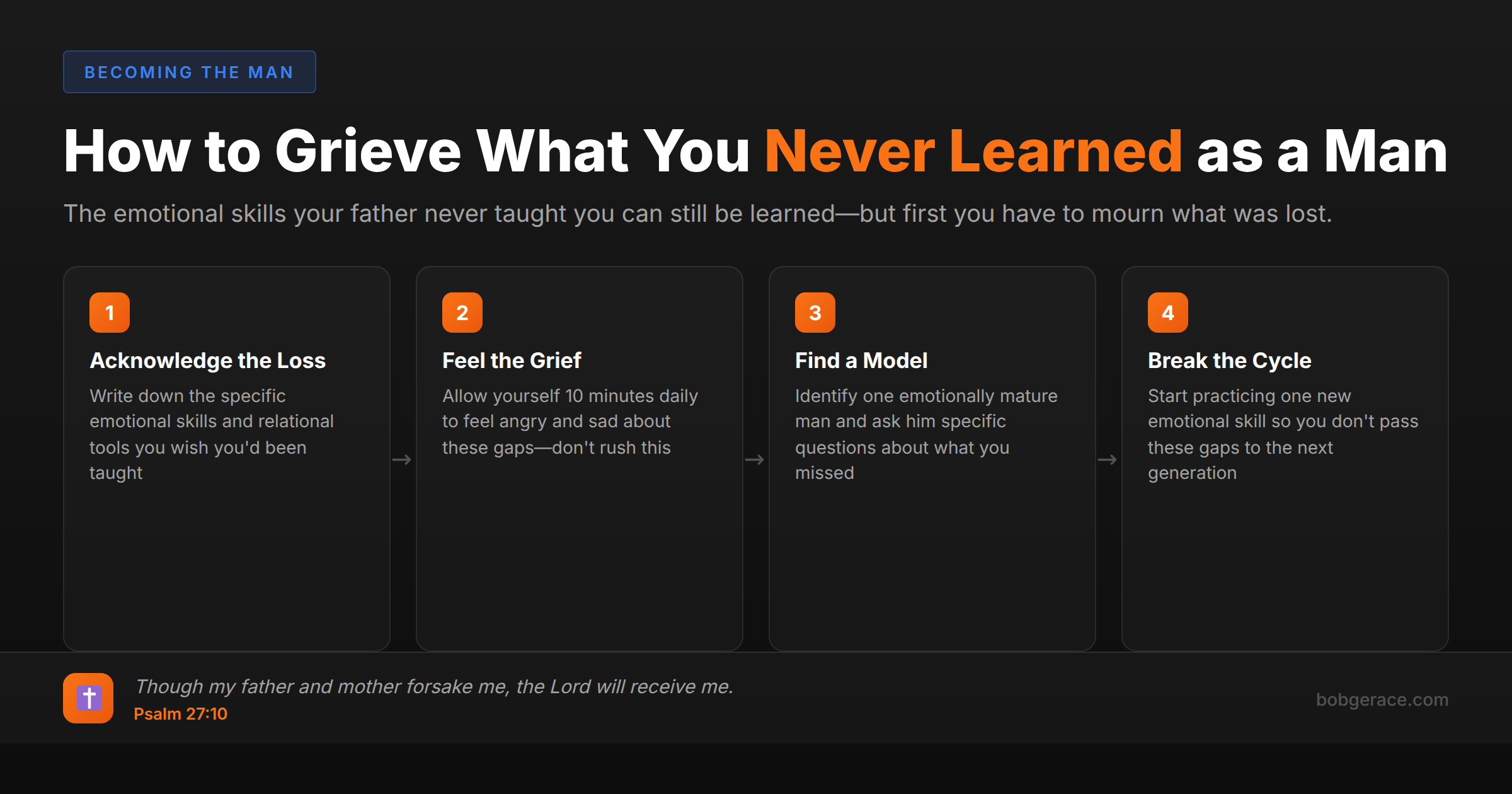
Grieving what you weren't taught starts with acknowledging the real loss. Many men were never shown how to process emotions, connect deeply with their wives, or lead their families with both strength and tenderness. This isn't about blaming your father—it's about recognizing that you missed out on crucial life skills, and that loss deserves to be mourned. The grief process involves naming what you didn't receive, feeling the anger and sadness that comes with that recognition, and then choosing to learn these skills now. You can't change your past, but you can refuse to pass these gaps on to the next generation. This work is hard, but it's how you break generational cycles.
The Full Picture
Most men carry invisible wounds from what they didn't learn growing up. Maybe your father was physically present but emotionally absent. Maybe he worked three jobs to provide but never taught you how to have a real conversation with your wife. Maybe he was a good man who simply didn't know how to model emotional intelligence because his father didn't teach him either.
The reality is this: you can't give what you don't have. If you weren't taught how to identify your feelings, you'll struggle to connect with your wife's emotions. If you weren't shown healthy conflict resolution, you'll either explode or shut down when disagreements arise. If you never saw a man apologize genuinely, you'll fumble through making amends when you mess up.
This isn't about becoming soft or overly emotional. It's about becoming complete. A truly masculine man can access his full range of emotions and use them as tools for connection, leadership, and protection. He can sit with his wife's pain without trying to fix it immediately. He can admit when he's wrong without feeling like less of a man.
The grief you feel about these missing pieces is legitimate. You lost out on essential training for manhood, marriage, and fatherhood. That gap has probably cost you in your relationships, your marriage, and your ability to raise emotionally healthy children. Acknowledging this loss isn't weakness—it's the first step toward wholeness.
What's Really Happening
What you're experiencing is called 'disenfranchised grief'—mourning a loss that society doesn't typically recognize or validate. Men especially struggle with this because we're not culturally encouraged to grieve intangible losses like missing emotional education or absent mentorship.
Neurologically, your brain formed neural pathways based on what you observed and experienced growing up. If emotional expression was discouraged or modeled poorly, your brain literally wired itself to avoid or mishandle emotional situations. The good news is that neuroplasticity means you can rewire these patterns, but it requires intentional practice and often involves grieving the 'father wound'—the gap between what you needed and what you received.
This grief often manifests as anger first, which feels safer for men than sadness. You might feel angry at your father, angry at yourself for not figuring it out sooner, or angry at the unfairness of having to learn these skills as an adult. This anger is part of the process, but staying stuck there keeps you from the deeper healing that comes through acknowledging the sadness underneath.
The goal isn't to become someone you're not, but to integrate the emotional competencies that support healthy relationships. This integration work often brings up shame—the feeling that you should already know these things. Remember: you're not deficient; you're developing skills you simply weren't taught.
What Scripture Says
Scripture acknowledges that we all come from broken lineages and need restoration. Psalm 27:10 reminds us: *'Though my father and mother forsake me, the Lord will receive me.'* Even when earthly fathers fall short, our Heavenly Father provides what we need for complete manhood.
Malachi 4:6 speaks of God's desire to *'turn the hearts of the fathers to their children, and the hearts of the children to their fathers.'* This restoration often begins with men like you who choose to break generational patterns. When you do the hard work of learning what you weren't taught, you're participating in God's redemptive plan.
Jesus himself models the full range of human emotion. John 11:35 simply states: *'Jesus wept.'* He grieved, felt righteous anger, experienced loneliness, and expressed deep compassion. Ephesians 4:26 instructs us to *'be angry and do not sin,'* acknowledging that emotions themselves aren't the problem—it's what we do with them that matters.
Isaiah 61:1-3 promises that God will *'bind up the brokenhearted'* and give us *'beauty for ashes, the oil of joy for mourning.'* Your willingness to grieve what you didn't receive positions you to receive God's healing and become the man, husband, and father He designed you to be. Proverbs 27:17 reminds us that *'iron sharpens iron,'* and sometimes God uses other men, counselors, or mentors to teach us what we missed along the way.
What To Do Right Now
-
1
Write down specifically what emotional skills or relational tools you wish you had been taught—don't hold back
-
2
Allow yourself to feel angry and sad about these losses for a set period each day—even 10 minutes matters
-
3
Identify one man in your life who models the emotional maturity you want to develop and ask him specific questions
-
4
Apologize to your wife for ways your emotional gaps have affected your marriage—be specific and don't expect immediate forgiveness
-
5
Start practicing one new emotional skill this week (like naming your feelings out loud or asking better questions)
-
6
Consider professional counseling or a men's group where you can process this grief with other men doing similar work
Related Questions
Ready to Break the Cycle?
You don't have to figure this out alone. Get the support and tools you need to become the emotionally mature man your family deserves.
Work With Me →