How do I regulate my own system?
6 min read
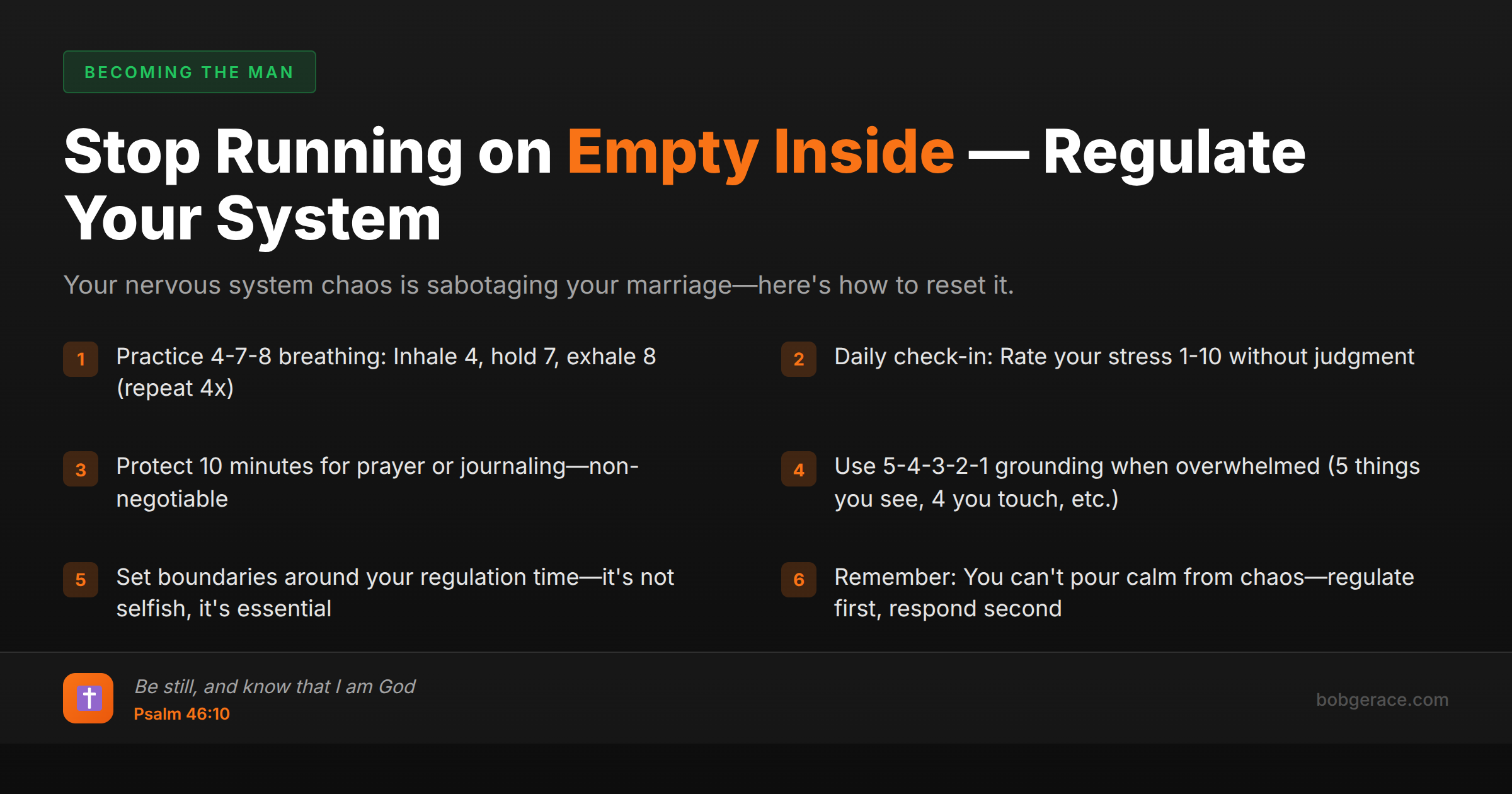
System regulation means bringing your nervous system back to a calm, balanced state when stress or emotions threaten to overwhelm you. This isn't about suppressing feelings—it's about creating stability so you can respond wisely rather than react impulsively. Simple techniques like deep breathing, grounding exercises, and setting boundaries help reset your internal thermostat. As a wife, your regulated nervous system becomes a gift to your marriage. When you're grounded and centered, you create space for healthy communication and connection. This isn't selfish—it's essential. You cannot pour from an empty cup, and you cannot give calm when you're operating from chaos inside.
The Full Picture
Your nervous system is constantly scanning for safety or threat, and modern marriage pressures can keep it stuck in survival mode. Between managing household responsibilities, navigating relationship dynamics, career demands, and emotional labor, your system can become chronically dysregulated—leaving you feeling anxious, overwhelmed, or emotionally reactive.
Understanding Your Nervous System States: - Sympathetic activation: Fight-or-flight mode triggered by conflict, criticism, or overwhelm - Dorsal vagal shutdown: The freeze response when you feel hopeless or disconnected - Ventral vagal engagement: Your optimal state for connection, creativity, and clear thinking
Regulation isn't about perfect control—it's about developing awareness of your internal state and having tools to guide yourself back to safety and connection. Think of it like learning to drive: initially everything feels overwhelming, but with practice, small adjustments become automatic.
Common Dysregulation Triggers in Marriage: - Feeling unheard or dismissed by your spouse - Financial stress or major life transitions - Parenting pressures and sleep deprivation - Past trauma activated by present circumstances - Chronic people-pleasing or boundary violations
The goal isn't to eliminate stress but to build resilience—the ability to move through difficult emotions and return to your center. When you're regulated, you can engage conflict constructively, communicate needs clearly, and show up authentically in your marriage.
What's Really Happening
From a neurobiological perspective, regulation involves the interplay between your autonomic nervous system and higher brain functions. When dysregulated, the amygdala hijacks rational thinking, flooding your system with stress hormones that make everything feel urgent and threatening.
The key is understanding that regulation is a skill, not a personality trait. Women often carry additional emotional labor in relationships, making nervous system overwhelm more common. Your body may be stuck in hypervigilance—constantly scanning for problems to solve or people to care for—without adequate recovery time.
Physiological Signs of Dysregulation: - Shallow breathing or breath-holding - Muscle tension, especially jaw and shoulders - Racing thoughts or mental fog - Sleep disruption and digestive issues - Emotional reactivity or numbness
Effective regulation combines top-down approaches (cognitive strategies like reframing thoughts) with bottom-up techniques (somatic practices like breathwork and movement). The vagus nerve—your body's major calming pathway—strengthens with consistent practice, creating greater emotional resilience over time.
In marriage therapy, I see dramatic shifts when wives prioritize their own regulation. It's not about becoming emotionally unavailable—it's about responding from a grounded place rather than reacting from triggered states. This creates safety for both partners and models healthy emotional management.
What Scripture Says
God designed you with an intricate nervous system that reflects His intentional care for your well-being. Scripture consistently calls us to peace, not as passive resignation but as active trust in God's sovereignty even amid life's storms.
"Be still, and know that I am God; I will be exalted among the nations, I will be exalted in the earth." - Psalm 46:10 Stillness isn't inactivity—it's centered trust. When your system is regulated, you can access this deep knowing of God's presence and control.
"Peace I leave with you; my peace I give you. I do not give to you as the world gives. Do not let your hearts be troubled and do not be afraid." - John 14:27 Christ offers supernatural peace that transcends circumstances. Regulation creates space to receive this gift rather than being consumed by anxiety.
"Cast all your anxiety on him because he cares for you." - 1 Peter 5:7 This verse describes a nervous system practice—literally transferring the weight of worry to God through prayer and surrender.
"In your anger do not sin: Do not let the sun go down while you are still angry." - Ephesians 4:26 This isn't about suppressing anger but processing it wisely. Regulation allows you to feel anger without being controlled by it.
"She is clothed with strength and dignity; she can laugh at the days to come." - Proverbs 31:25 A regulated nervous system embodies this biblical femininity—strong yet peaceful, prepared but not anxious.
"Let the peace of Christ rule in your hearts." - Colossians 3:15 Regulation allows Christ's peace to govern your responses rather than being ruled by emotional reactivity.
What To Do Right Now
-
1
Practice the 4-7-8 breathing technique: Inhale for 4 counts, hold for 7, exhale for 8. Repeat 4 times to activate your parasympathetic nervous system.
-
2
Create a daily check-in ritual: Ask yourself 'How is my nervous system right now?' Rate your stress 1-10 and notice without judgment.
-
3
Establish non-negotiable boundaries around your regulation time—even 10 minutes of morning prayer or evening journaling protects your internal stability.
-
4
Use the 5-4-3-2-1 grounding technique when overwhelmed: Name 5 things you see, 4 you can touch, 3 you hear, 2 you smell, 1 you taste.
-
5
Implement the pause practice: When triggered, say 'Let me think about this' and take three deep breaths before responding to your spouse.
-
6
Build your regulation toolkit with activities that consistently restore you: worship music, nature walks, warm baths, scripture reading, or gentle movement.
Related Questions
- What does nervous system regulation look like?
- How do I stay in prefrontal cortex during conflict?
- What is 'window of tolerance' and how do I widen mine?
- How do I self-regulate before I connect?
- What does emotional co-regulation look like?
- How do I widen the gap between stimulus and response?
- What's happening to my nervous system right now?
- How do I function when my body won't calm down?
- What is the 'trauma loop' and how do I interrupt it?
- How do I co-regulate when she's dysregulated too?
Also find Bob on
Subscribe for weekly videos on Christian marriage.
Your Marriage Needs Your Specific Work
Regulation isn't one-size-fits-all. A coach who knows your story can help you build the exact practices that work for your nervous system and your marriage.
Talk to Bob →