What boundaries should I set?
6 min read
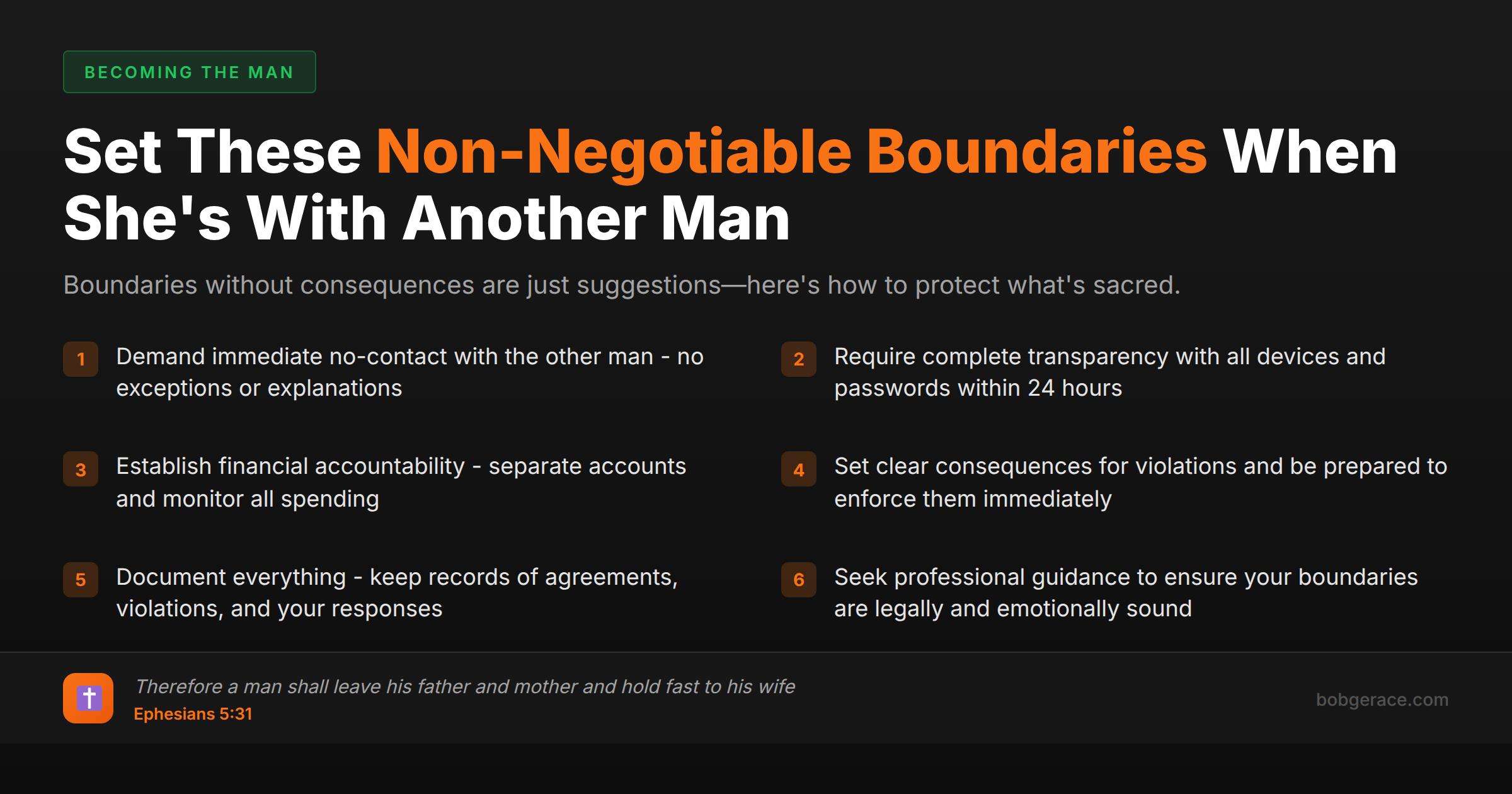
When your wife is involved with another man, you need clear, non-negotiable boundaries immediately. These aren't about control—they're about protecting what's sacred and creating conditions for healing. Essential boundaries include: no contact with the other man in any form, complete transparency with all devices and accounts, and immediate cessation of behaviors that violate your marriage covenant. Boundaries without consequences are just suggestions. You must be prepared to enforce them consistently. This might mean separating bank accounts, changing living arrangements, or seeking legal counsel. Remember, boundaries protect both of you from further damage and create space for genuine repentance and restoration to occur.
The Full Picture
Setting boundaries when there's another man isn't about being controlling or punitive—it's about creating a protective framework that honors the sanctity of marriage and provides clear expectations for moving forward. Many men struggle with this because they fear being seen as harsh or driving their wife further away. But the opposite is true: clear boundaries demonstrate that marriage matters and create safety for both spouses.
The primary boundary is complete cessation of contact with the other man. This means no phone calls, texts, emails, social media interactions, or in-person meetings. Delete and block all contact information. If they work together, she needs to find new employment or request a transfer. This isn't negotiable—continued contact makes restoration impossible.
Technology transparency is equally critical. All passwords must be shared, location services enabled, and devices open for inspection at any time. If she's unwilling to provide complete transparency, she's not truly committed to rebuilding trust. This includes email accounts, social media, messaging apps, and even seemingly innocent platforms like LinkedIn.
Financial boundaries protect your family's resources from being used to sustain the inappropriate relationship. This might mean separate accounts temporarily, removing her access to credit cards, or requiring receipts for all expenditures. Money spent on another man is money stolen from your family.
Physical boundaries may include temporary separation if she's unwilling to end the relationship immediately. This doesn't mean you're giving up—it means you're refusing to enable destructive behavior while she decides what she truly wants.
What's Really Happening
From a clinical perspective, boundaries serve multiple psychological functions during infidelity recovery. They provide external structure when internal moral boundaries have failed, creating clear expectations that reduce ambiguity and anxiety for both partners. Research shows that affairs thrive in environments of secrecy and unclear expectations, so boundaries directly counteract these conditions.
Boundaries also interrupt the neurochemical addiction cycle that often develops during affairs. The brain chemistry involved in infidelity mirrors addiction patterns, with dopamine surges reinforcing the secretive behavior. By eliminating contact and access, you're forcing withdrawal from this chemical dependency, which is necessary but temporarily increases resistance.
Many wives initially react to boundaries with anger or claims that you're being controlling. This resistance is actually predictable and indicates the boundaries are necessary. If the relationship were truly innocent or over, transparency wouldn't feel threatening. The intensity of her reaction often correlates with the depth of emotional investment in the other relationship.
It's crucial to understand that boundaries are for you, not her. You can't control her choices, but you can control what you will and won't accept in your marriage. This shift from trying to control her behavior to managing your own responses is psychologically empowering and often motivates genuine change in the relationship dynamic.
What Scripture Says
Scripture provides clear guidance on boundaries and accountability within marriage. Ephesians 5:31-32 reminds us that marriage creates 'one flesh,' making outside romantic attachments a violation of this sacred unity. When someone breaks this covenant, restoration requires clear boundaries and genuine repentance.
Matthew 18:15-17 outlines the process for addressing sin within relationships: first privately, then with witnesses, and finally with community accountability. This principle applies to marital unfaithfulness—consequences escalate when private correction is ignored.
1 Corinthians 5:11-13 instructs believers not to associate with those who claim faith but live in persistent sin. While this doesn't immediately apply to divorce, it does support the concept of separation when someone refuses to abandon destructive behavior. Sometimes loving someone means refusing to enable their sin.
Galatians 6:1-2 calls us to restore those caught in sin gently, while also bearing one another's burdens. However, verse 5 reminds us that 'each will bear his own load'—everyone is ultimately responsible for their own choices. You can't carry the weight of her decisions.
Proverbs 27:5-6 teaches that 'faithful are the wounds of a friend' and 'open rebuke is better than hidden love.' Setting firm boundaries may feel harsh, but it's often the most loving response to destructive behavior. True love confronts sin rather than enabling it.
Boundaries aren't about punishment—they're about creating space for repentance, accountability, and genuine restoration as outlined throughout Scripture's approach to addressing sin and rebuilding trust.
What To Do Right Now
-
1
Demand immediate no-contact with the other man - no exceptions, explanations, or gradual withdrawal
-
2
Require complete transparency with all devices, passwords, and accounts within 24 hours
-
3
Establish financial accountability - separate accounts if necessary and monitor all spending
-
4
Set clear consequences for boundary violations and be prepared to enforce them immediately
-
5
Document everything - keep records of agreements, violations, and your responses
-
6
Seek professional guidance to ensure your boundaries are appropriate and legally sound
Related Questions
- What's the difference between boundary and ultimatum?
- What makes boundaries effective vs. empty threats?
- What is a 'natural consequence' vs. 'punishment'?
- How do I set boundaries without controlling?
- What does 'holding space' while 'holding boundary' look like?
- How do I stay connected while enforcing boundaries?
- Should I give her space or fight for her?
- She wants separation — should I agree?
- What are the rules of separation?
- What is a boundary vs. an ultimatum?
Also find Bob on
Subscribe for weekly videos on Christian marriage.
Your Marriage Needs a Coach Today
Setting boundaries is one thing. Enforcing them when she's still in contact with him—when you're flooded, second-guessing, alone at 2 AM—is another. Bob knows your specific situation and what actually works in the next 30 days.
Talk to Bob →