What makes change sustainable vs. temporary?
6 min read
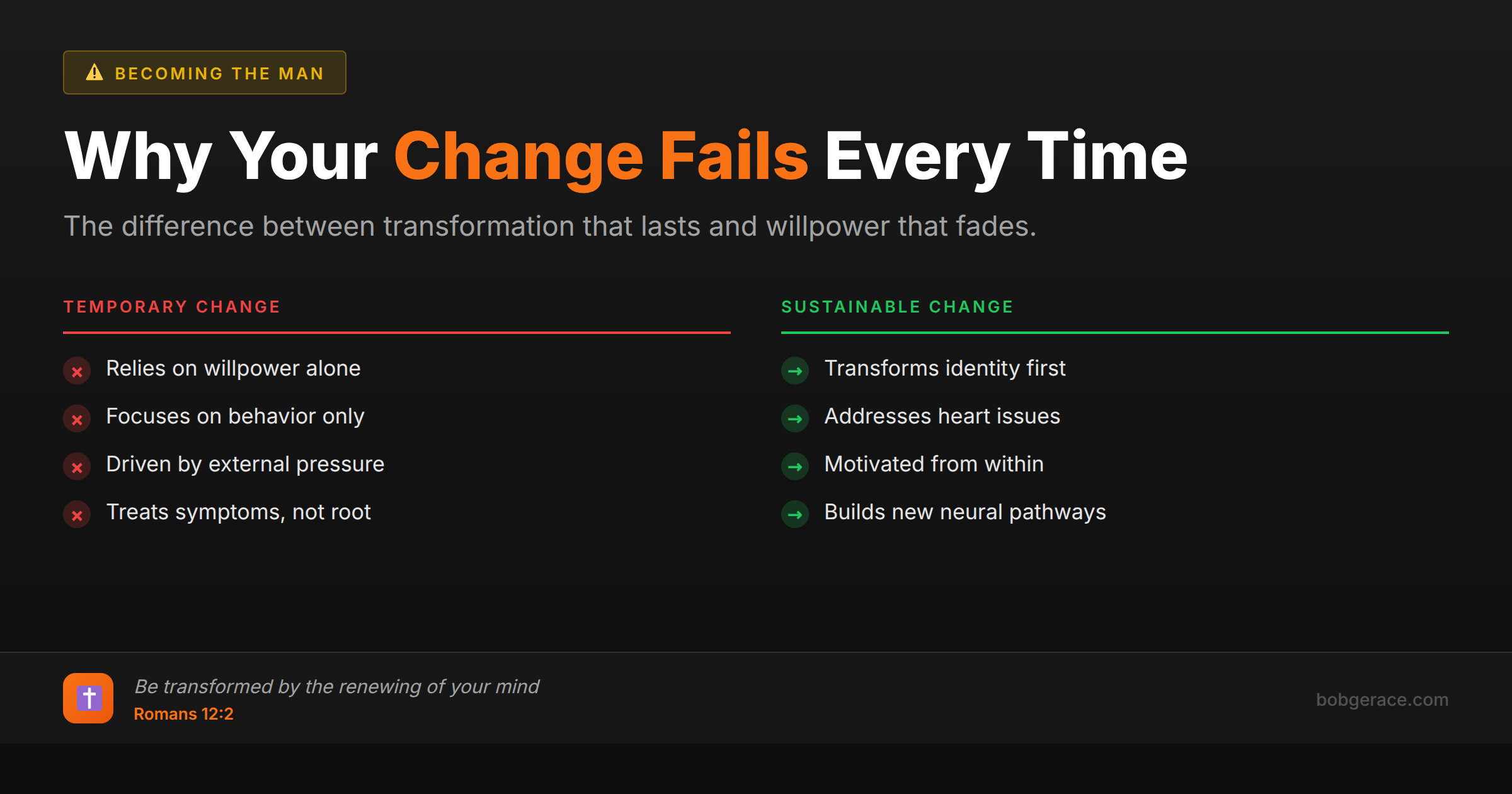
Sustainable change is rooted in identity transformation and driven by intrinsic motivation, while temporary change relies on external pressure and behavior modification alone. The difference lies in whether you're changing from the inside out or just managing symptoms. Sustainable change happens when you address the heart issues behind your behaviors, develop new neural pathways through consistent practice, and align your actions with your deeper values and identity. Temporary change occurs when you rely on willpower, fear, or external accountability without doing the deeper work of transformation. It's like treating a wound with a bandage versus actually healing the injury.
The Full Picture
Here's what most men don't understand: sustainable change requires a complete shift in how you see yourself, not just adjustments to what you do.
Temporary changes are like putting new tires on a car with engine problems. You might get better traction for a while, but the underlying issues will eventually surface. These changes typically rely on:
- External motivation (fear of divorce, social pressure) - Willpower alone (white-knuckling through challenges) - Behavior modification without heart change - Crisis-driven decisions that fade when the crisis passes - Shame-based motivation that creates internal resistance
Sustainable change, on the other hand, is like rebuilding the engine entirely. It involves:
Identity-level transformation where you literally become a different kind of man. Your neural pathways rewire. Your default responses shift. Your character deepens.
Intrinsic motivation that comes from knowing who you're called to be, not just reacting to circumstances or trying to avoid consequences.
Systems and structures that support the new you, rather than relying on motivation alone.
Community and accountability that reinforces your growth rather than enabling old patterns.
The key difference is this: temporary change asks "How can I fix this problem?" while sustainable change asks "Who do I need to become?" One is about managing symptoms; the other is about transformation at the cellular level.
What's Really Happening
From a neurological perspective, sustainable change occurs when we create new neural pathways through consistent repetition and emotional engagement, while temporary change relies on prefrontal cortex override that's easily depleted.
The brain has remarkable plasticity, but lasting change requires what we call 'myelination' - the strengthening of neural pathways through repeated use. When men try to change through willpower alone, they're essentially asking their prefrontal cortex to constantly override their limbic system. This creates what researchers call 'decision fatigue' and explains why temporary changes collapse under stress.
Sustainable change happens when three elements align: cognitive understanding (knowing what needs to change), emotional engagement (feeling motivated to change), and behavioral practice (consistently acting on the change). This creates what neuroscientists call 'Hebbian learning' - neurons that fire together, wire together.
The most critical factor is addressing the underlying attachment patterns and core beliefs that drive behavior. Men who focus only on surface behaviors without examining their attachment styles, childhood wounds, or core beliefs about themselves find that stress triggers their old patterns regardless of their conscious intentions.
This is why sustainable change often requires processing past wounds, developing emotional intelligence, and creating new relational experiences that literally rewire the brain's relational circuitry. It's not enough to know what to do differently - you need to feel safe enough in your nervous system to actually do it consistently.
What Scripture Says
Scripture makes a clear distinction between surface-level change and heart transformation. The Bible consistently points to sustainable change as a work that begins in the heart and flows outward.
Romans 12:2 tells us: *"Do not conform to the pattern of this world, but be transformed by the renewing of your mind."* The Greek word for 'transformed' is 'metamorphosis' - the same process a caterpillar undergoes to become a butterfly. This isn't behavior modification; it's complete transformation.
Ezekiel 36:26 reveals God's method: *"I will give you a new heart and put a new spirit in you; I will remove from you your heart of stone and give you a heart of flesh."* Sustainable change starts with a heart transplant, not a behavior adjustment.
2 Corinthians 5:17 declares: *"Therefore, if anyone is in Christ, the new creation has come: The old has gone, the new is here!"* This is identity-level change - you literally become a new creation.
Philippians 2:13 shows us the power source: *"For it is God who works in you to will and to act in order to fulfill his good purpose."* Sustainable change isn't powered by your willpower alone, but by God's power working within you.
Galatians 2:20 captures the essence: *"I have been crucified with Christ and I no longer live, but Christ lives in me."*
James 1:22-24 warns against temporary, surface change: *"Do not merely listen to the word, and so deceive yourselves. Do what it says. Anyone who listens to the word but does not do what it says is like someone who looks at his face in a mirror and, after looking at himself, goes away and immediately forgets what he looks like."*
True biblical change involves dying to the old self and being raised as a new creation. It's supernatural, sustainable, and starts in the heart.
What To Do Right Now
-
1
Identify the heart issue behind your behavior patterns - ask 'What belief about myself is driving this action?'
-
2
Create identity-based goals instead of behavior-based goals - 'I am becoming a man who...' rather than 'I will stop doing...'
-
3
Establish daily practices that reinforce your new identity - prayer, reflection, and actions that align with who you're becoming
-
4
Build supportive systems and accountability that reinforce transformation rather than just monitoring behavior
-
5
Address past wounds and limiting beliefs through counseling, prayer, or coaching that gets to root issues
-
6
Connect your change to your deeper purpose and calling - link it to something bigger than yourself
Related Questions
- What does real transformation look like?
- How do I change from the inside out?
- What's the difference between first-order and second-order change?
- What is 'identity-based change'?
- Why does behavior change without belief change fail?
- How long does it take to rewire the brain?
- How long does recovery take?
- What is 'white-knuckling' vs. real transformation?
- What is the typical betrayal trauma recovery timeline?
- How long does real change actually take?
Also find Bob on
Subscribe for weekly videos on Christian marriage.
You Don't Have to Keep Guessing Alone
A coach who knows your marriage can see what's actually blocking change in your specific situation—and help you build something that holds.
Talk to Bob →