What will he do when I test him?
6 min read
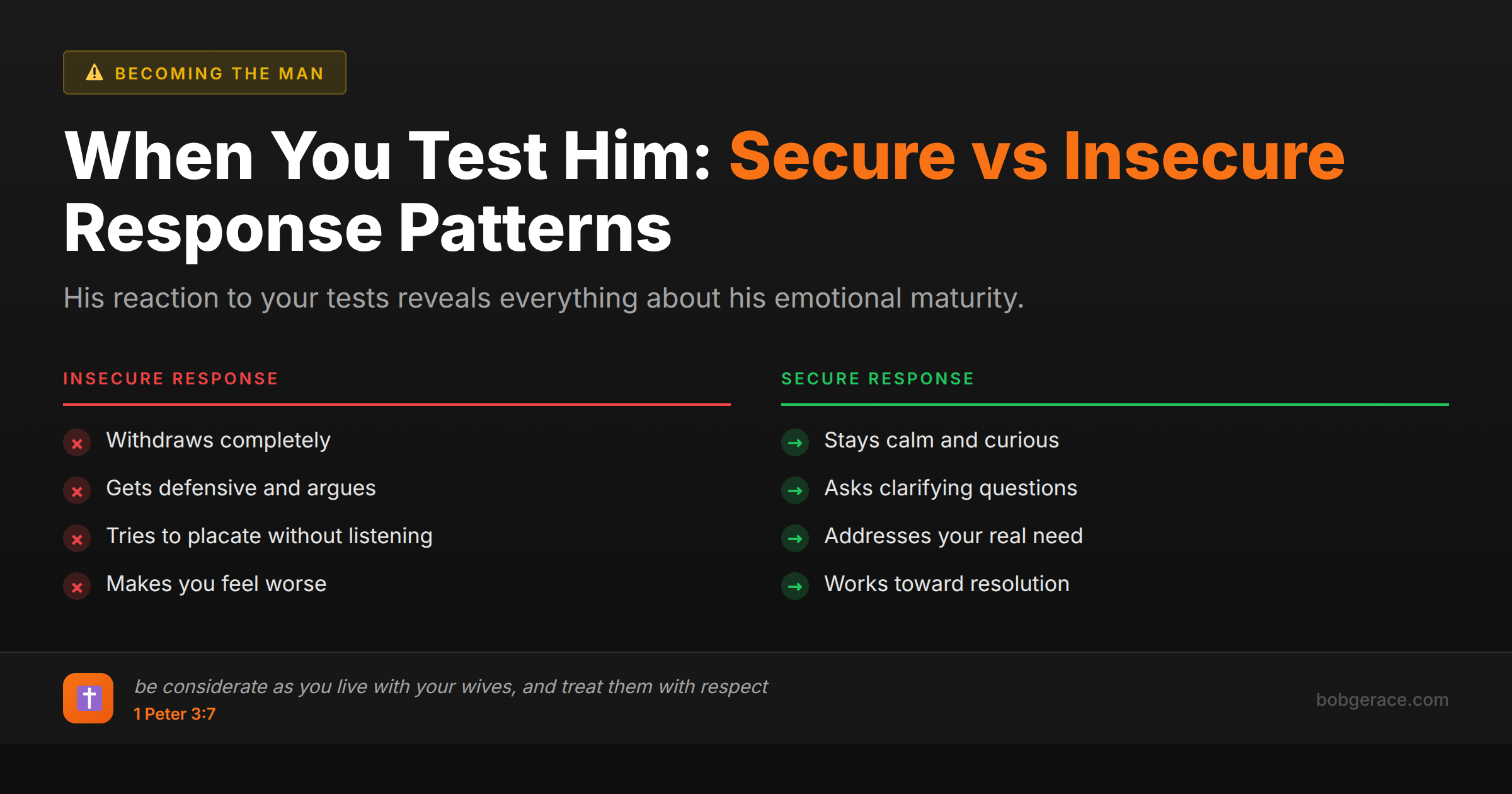
His response to your tests will reveal his attachment style and emotional maturity level. A securely attached husband will remain calm, ask clarifying questions, and work toward resolution even when you're pushing boundaries. He'll see through the test to your underlying need and address that instead of just reacting to your behavior. An insecurely attached husband might withdraw completely, become defensive and argumentative, or try to placate you without addressing the real issue. These responses often make you feel more insecure, creating a cycle where you test more frequently. Understanding his typical patterns helps you recognize whether you're dealing with someone who can handle emotional challenges or someone who needs to grow in this area.
The Full Picture
When women test their husbands, they're usually seeking reassurance about the relationship's security and their husband's commitment. These tests often happen unconsciously and can range from subtle emotional withdrawal to more direct challenges about priorities or faithfulness.
The Secure Response Pattern: A husband with secure attachment will typically respond with curiosity rather than defensiveness. He'll ask questions like "What's really going on?" or "How can I help you feel better about this?" He won't take the bait of surface-level conflict but will dig deeper to understand your underlying concerns. This response actually reduces your need to test because you feel heard and valued.
The Anxious Response Pattern: An anxiously attached husband might become overly accommodating, desperately trying to fix things without understanding what's wrong. He might make promises he can't keep or become emotional himself, which can feel overwhelming rather than reassuring.
The Avoidant Response Pattern: The avoidant husband will often shut down, get angry about being "tested," or dismiss your concerns as irrational. He might say things like "Here we go again" or "Nothing I do is ever good enough." This response typically escalates your anxiety and leads to more testing.
The Disorganized Response Pattern: Some husbands swing between different responses unpredictably - sometimes withdrawing, sometimes getting angry, sometimes being overly accommodating. This inconsistency creates the most anxiety and often intensifies the testing cycle.
Recognizing these patterns helps you understand whether your husband has the emotional tools to create the security you're seeking, or whether this is an area where growth is needed.
What's Really Happening
From a clinical perspective, relationship testing is often an unconscious strategy to assess emotional safety and attachment security. When a woman tests her partner, her nervous system is essentially asking: "Can I count on you when I'm vulnerable?"
The husband's response activates either the bonding system or the threat detection system in her brain. A calm, curious response signals safety and strengthens attachment bonds. Defensive, angry, or dismissive responses trigger threat detection, leading to more testing behaviors as she seeks the reassurance she didn't receive.
Neurologically, secure individuals have better emotional regulation in their prefrontal cortex, allowing them to respond thoughtfully rather than reactively. They can separate the testing behavior from the person and address underlying needs. Insecurely attached individuals often have more reactive amygdala responses, leading to fight, flight, or freeze reactions.
This creates what we call "negative sentiment override" - where neutral or even positive interactions get interpreted negatively because the nervous system is already primed for threat. The testing intensifies as the woman's attachment system seeks the co-regulation it needs but isn't receiving.
Understanding this cycle is crucial because it reveals that testing isn't manipulation - it's often a dysregulated nervous system seeking safety. The most effective response involves emotional attunement and consistent, predictable behavior over time rather than trying to "pass" individual tests.
What Scripture Says
Scripture provides wisdom about how husbands should respond when their wives are struggling with insecurity or fear, even when it manifests as testing behavior.
Responding with Understanding: "Husbands, in the same way be considerate as you live with your wives, and treat them with respect as the weaker partner and as heirs with you of the gracious gift of life" (1 Peter 3:7). The word "considerate" implies understanding her emotional needs and responding with wisdom rather than reaction.
Patience in Difficult Moments: "Love is patient, love is kind. It does not envy, it does not boast, it is not proud. It does not dishonor others, it is not self-seeking, it is not easily angered, it keeps no record of wrongs" (1 Corinthians 13:4-5). This describes exactly how a husband should respond during testing - with patience rather than anger.
Gentle Responses: "A gentle answer turns away wrath, but a harsh word stirs up anger" (Proverbs 15:1). When you're testing, a harsh or defensive response will escalate the situation, while gentleness can de-escalate and create connection.
Sacrificial Love: "Husbands, love your wives, just as Christ loved the church and gave himself up for her" (Ephesians 5:25). Christ's love for the church wasn't conditional on the church being perfect - it was sacrificial even when the church was struggling.
Bearing Burdens: "Carry each other's burdens, and in this way you will fulfill the law of Christ" (Galatians 6:2). Your testing often represents emotional burdens you're carrying. A godly husband will help carry those burdens rather than adding to them through defensive reactions.
God's design is for husbands to be a source of security and stability, reflecting Christ's unchanging love for His bride, the church.
What To Do Right Now
-
1
Observe his typical response patterns without judgment - notice if he gets defensive, withdraws, or stays curious and engaged
-
2
Recognize that testing often happens when you're feeling insecure - identify what triggered your need for reassurance
-
3
Communicate directly about your underlying concerns instead of testing indirectly - say what you actually need
-
4
Appreciate and reinforce positive responses when he does handle your emotions well - this encourages more of the same behavior
-
5
Set boundaries around destructive responses - don't engage with anger, contempt, or stonewalling behaviors
-
6
Consider whether his consistent response patterns indicate someone who can grow with help or someone who needs professional intervention
Related Questions
Need Help Understanding Your Dynamic?
If you're caught in testing cycles that aren't creating the security you need, let's work together to build healthier patterns of connection.
Get Support →