How do I assess how far gone she is?
6 min read
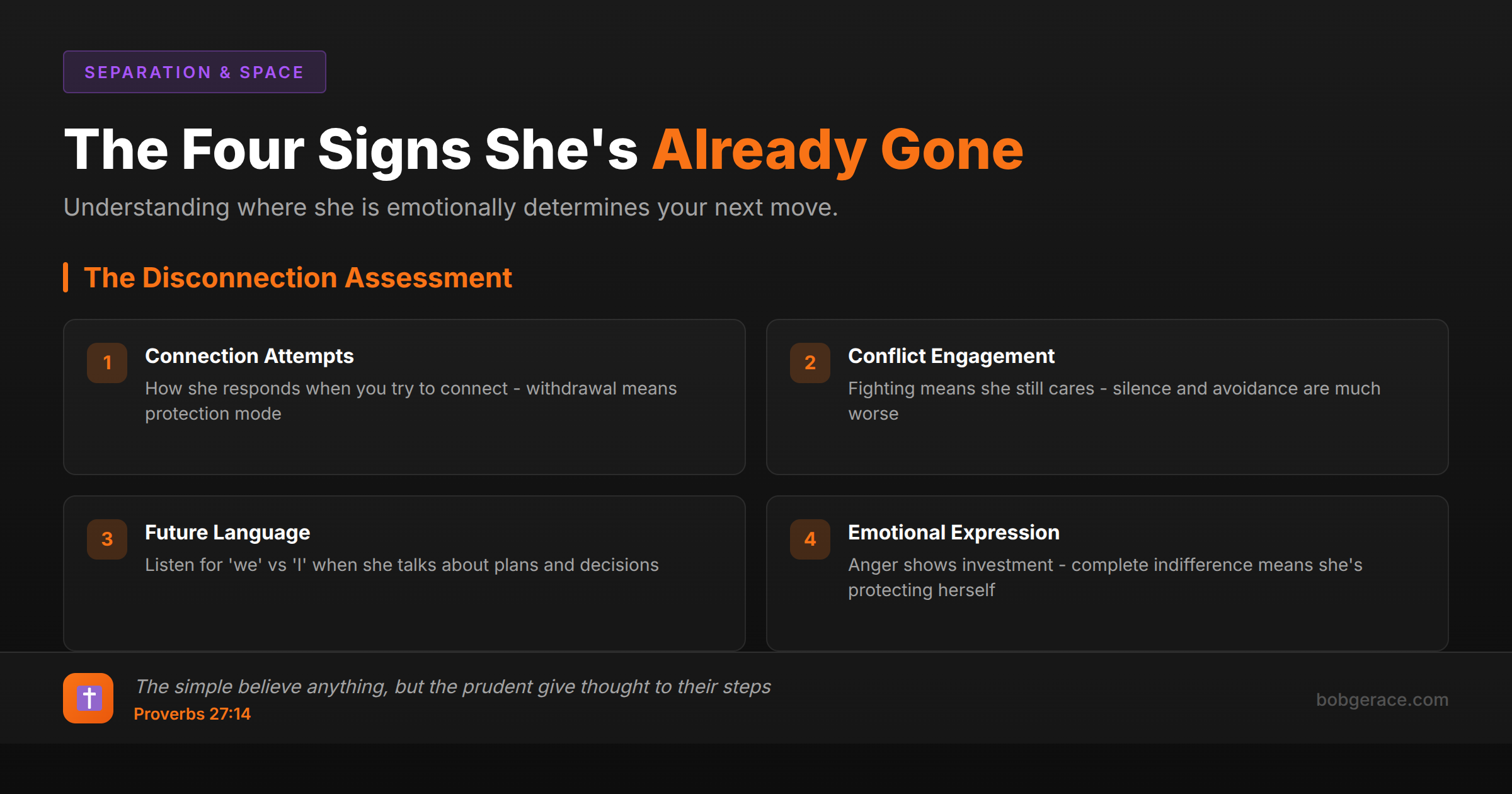
Assessing your wife's level of disconnection requires looking at specific behavioral and emotional indicators. The key markers include: how she responds to your attempts at connection, whether she's still willing to engage in conflict (silence is often worse than fighting), her investment in shared activities and decisions, and most importantly, whether she still expresses hurt or anger versus complete indifference. Indifference is the most dangerous stage - it means she's emotionally protecting herself by shutting down completely. If she's still fighting or showing emotion, there's still connection to work with. The goal isn't to diagnose her, but to understand where you stand so you can respond appropriately.
The Full Picture
Understanding where your wife stands emotionally isn't about labeling or categorizing her - it's about recognizing the reality so you can respond effectively. Many men operate on false hope or complete despair without accurately assessing the situation.
The Spectrum of Disconnection:
*Stage 1: Frustrated but Engaged* - She's still fighting, expressing needs, showing emotion (even negative). This is actually a good sign because she's still invested enough to be upset.
*Stage 2: Selective Withdrawal* - She's pulling back from certain areas but still engaged in others. Maybe she's distant physically but still involved in family decisions.
*Stage 3: Functional Coexistence* - She's going through the motions for practical reasons (kids, finances, social expectations) but emotional investment is minimal.
*Stage 4: Complete Disconnection* - Indifference has set in. She's not fighting because she doesn't care enough to fight. This is the most dangerous stage.
Key Assessment Areas:
- Communication patterns: Does she engage in conversations about the relationship or shut them down? - Physical connection: Complete avoidance or just reduced frequency? - Shared decisions: Is she still invested in family choices or has she checked out? - Future planning: Does she include 'we' in future discussions? - Conflict response: Fighting means caring; silence often means she's done.
Remember, this assessment isn't about her failure - it's about understanding where you both are so you can chart the right course forward.
What's Really Happening
From a clinical perspective, emotional withdrawal follows predictable patterns that we call the 'Cascade of Disconnection.' Understanding these stages helps us intervene effectively.
The Gottman Research Foundation identifies contempt, criticism, defensiveness, and stonewalling as relationship death predictors. But the most telling indicator is the presence or absence of what we call 'emotional bid responses.' When your wife stops making emotional bids (attempts to connect) or stops responding to yours, we're seeing significant disconnection.
Clinical Markers to Observe:
*Attachment Style Shifts*: Even securely attached individuals can shift toward avoidant patterns when overwhelmed. If she's historically been emotionally available and is now withdrawn, this suggests protective mechanisms are active.
*Emotional Labor Patterns*: Many women disconnect when they feel they're carrying disproportionate emotional labor in the relationship. Watch for signs she's stopped 'managing' the emotional climate of your home.
*Trauma Response Indicators*: Chronic disconnection can trigger trauma responses. If she seems to be in survival mode - focused only on essential functions - she may be experiencing relationship trauma.
The Critical Distinction: Anger and frustration indicate she's still fighting FOR the relationship. Indifference means she's protecting herself FROM the relationship. This distinction is crucial for intervention strategies.
Clinically, we see the best outcomes when partners accurately assess the situation without catastrophizing or minimizing. Your response must match her actual emotional state, not your fears or hopes about where she is.
What Scripture Says
Scripture calls us to wisdom and discernment in all relationships, including marriage. This isn't about judging your wife but about understanding the situation with godly wisdom.
Proverbs 27:14 reminds us that *'The simple believe anything, but the prudent give thought to their steps.'* Accurate assessment requires honest evaluation, not wishful thinking or denial.
Ecclesiastes 3:1 tells us *'To everything there is a season, and a time to every purpose under heaven.'* Understanding where your wife is emotionally helps you respond with appropriate timing and approach.
Jesus himself demonstrated this principle of wise assessment. Luke 14:28-30 shows Christ teaching about counting the cost and understanding the reality of situations before acting: *'For which of you, intending to build a tower, does not sit down first and count the cost, whether he has enough to finish it?'*
1 Corinthians 13:7 speaks of love that *'bears all things, believes all things, hopes all things, endures all things.'* This doesn't mean being naive about your situation, but rather loving wisely while maintaining hope.
The goal of assessment isn't condemnation but restoration. Galatians 6:1 instructs: *'Brothers and sisters, if someone is caught in a sin, you who live by the Spirit should restore that person gently.'* While disconnection isn't necessarily sin, the principle of gentle restoration applies.
James 1:5 promises: *'If any of you lacks wisdom, let him ask of God, who gives to all liberally.'* Ask God for wisdom to see your marriage clearly and respond with His heart.
What To Do Right Now
-
1
Document patterns objectively - Track her responses to your connection attempts over 2 weeks without making it obvious
-
2
Assess her conflict engagement - Note whether she still argues/discusses issues or has moved to silence and avoidance
-
3
Evaluate daily interactions - Count positive vs. neutral vs. negative exchanges to get a baseline
-
4
Look for 'we' language - Notice if she still speaks about future plans using 'we' or has shifted to 'I'
-
5
Test small connection attempts - Make simple, low-pressure bids for connection and observe responses
-
6
Pray for discernment - Ask God to show you the truth of your situation and wisdom for next steps
Related Questions
- What is 'emotional disengagement'?
- What's the difference between her being withdrawn and being done?
- Is her shutdown protective or permanent?
- What is 'deactivation' and did I cause it?
- What happened to her attachment to me?
- Can deactivated attachment reactivate?
- What are the stages of betrayal trauma recovery?
- What is 'negative sentiment override' and does she have it?
- What are the Four Horsemen and which ones killed us?
Also find Bob on
Subscribe for weekly videos on Christian marriage.
Get Bob's Read on Your Situation
You're reading behavioral tea leaves in a crisis. A coach who knows your specific marriage can tell you what you're actually dealing with and what to do in the next 30 days.
Talk to Bob →