What have I done that made connection feel unsafe?
6 min read
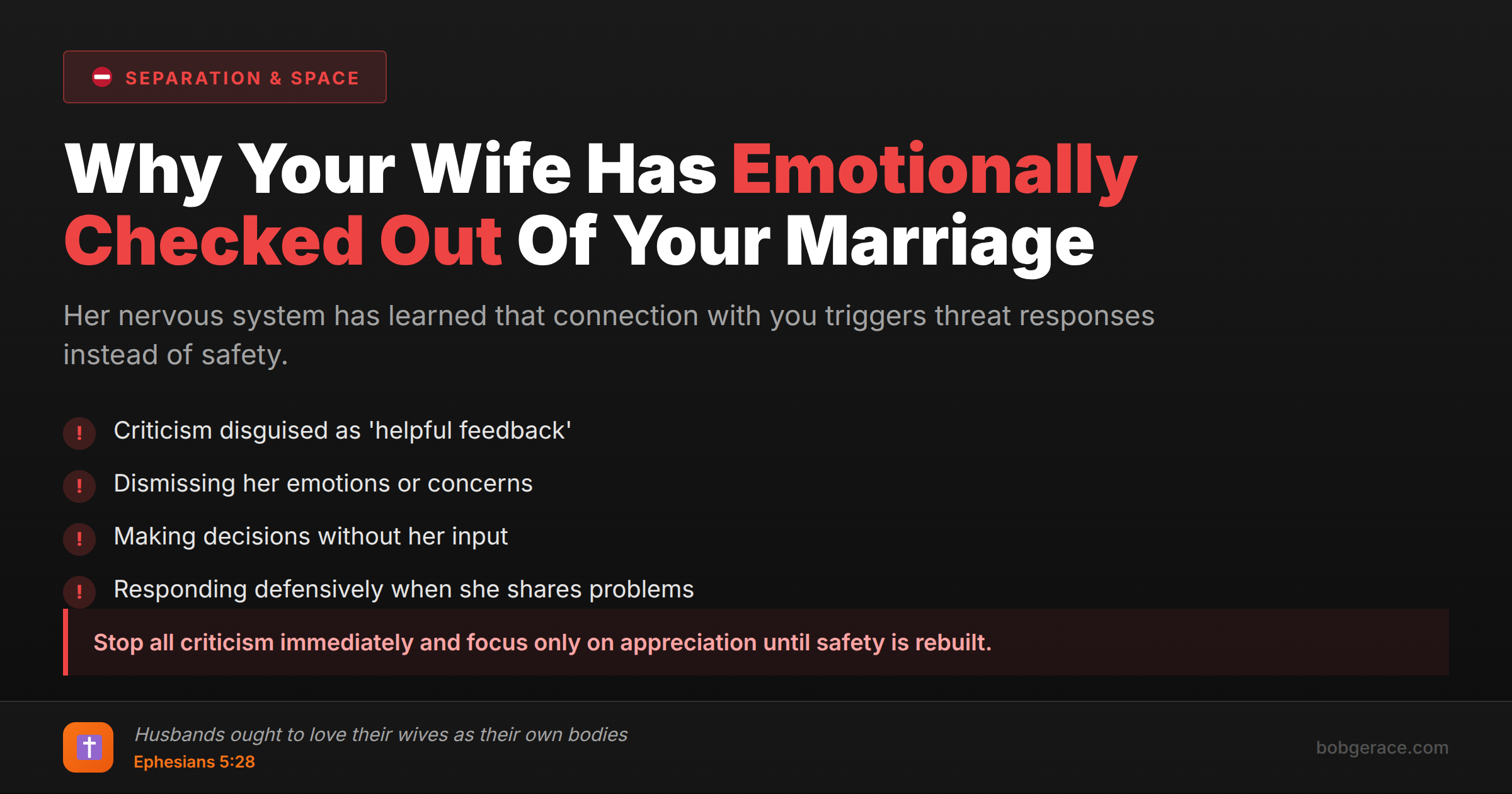
When your wife has checked out, it's often because her nervous system has learned that emotional connection with you triggers threat responses rather than safety. This isn't about dramatic abuse - it's usually the accumulation of smaller moments: criticism disguised as helpful feedback, dismissing her emotions, making decisions without her input, or responding defensively when she tries to share concerns. Your wife's brain is designed to prioritize safety above all else. When interactions consistently feel unpredictable, judgmental, or emotionally risky, her nervous system adapts by creating distance. She's not being dramatic or oversensitive - she's responding to genuine neurological signals that connection with you doesn't feel safe anymore.
The Full Picture
Understanding why connection feels unsafe requires looking beyond individual incidents to patterns of interaction. Your wife's nervous system is constantly scanning for safety cues, and when those signals consistently indicate threat, her brain will choose self-protection over intimacy every time.
Common behaviors that create unsafety include criticism masked as concern - those moments when you point out what she's doing wrong while claiming you're being helpful. Emotional invalidation happens when you tell her she's overreacting or being too sensitive instead of acknowledging her experience. Defensive responses when she tries to address problems teach her brain that bringing up issues leads to conflict rather than resolution.
Decision-making patterns also impact safety. When you make unilateral choices about finances, parenting, or major life decisions, you're communicating that her input doesn't matter. Inconsistent emotional availability - being warm and connected sometimes but distant and irritable at unpredictable intervals - creates an environment where she never knows which version of you she'll encounter.
The betrayal of everyday moments compounds over time. It's not just the big fights - it's the eye rolls, the sighs when she's talking, the times you're physically present but emotionally absent. Her nervous system catalogs these micro-rejections and eventually concludes that emotional vulnerability leads to pain.
This isn't about perfection - it's about recognizing patterns that have taught her brain that opening her heart to you is risky. The good news is that once you understand these dynamics, you can begin creating the consistent safety that allows connection to return.
What's Really Happening
From a neuroscience perspective, your wife's emotional withdrawal represents her nervous system's adaptive response to perceived relational threats. The polyvagal system, which governs our autonomic responses, has shifted her into protective states rather than the social engagement necessary for intimate connection.
When someone experiences chronic relational stress, their nervous system begins operating from what we call 'neuroception' - unconscious detection of safety versus danger. Your wife's brain may have learned to associate emotional vulnerability with you with activation of her sympathetic nervous system (fight-flight) or even dorsal vagal shutdown (withdrawal and numbing).
Repeated experiences of criticism, invalidation, or emotional unpredictability literally reshape neural pathways. The brain becomes hypervigilant to signs of rejection or judgment, making genuine intimacy neurologically difficult. This isn't a conscious choice - it's an automatic protective mechanism.
Trauma-informed research shows that safety must be established at the nervous system level before cognitive interventions can be effective. This means your wife can't simply 'decide' to reconnect - her autonomic nervous system must first receive consistent signals that emotional openness with you won't result in pain or rejection.
The repair process requires understanding that her nervous system needs repeated experiences of safety, attunement, and co-regulation. This means staying calm when she's activated, validating her emotions without trying to fix them, and demonstrating through consistent actions that you can be trusted with her vulnerability. Only when her polyvagal system shifts back into social engagement can genuine emotional and physical intimacy return.
What Scripture Says
Scripture consistently emphasizes the husband's role in creating safety and security within marriage. Ephesians 5:25-29 calls husbands to "love your wives as Christ loved the church and gave himself up for her... husbands ought to love their wives as their own bodies." This sacrificial love creates the safety that allows vulnerability to flourish.
1 Peter 3:7 instructs husbands to "live with your wives in an understanding way, showing honor to the woman as the weaker vessel, since they are heirs with you of the grace of life." The word "understanding" implies careful attention to her emotional and relational needs, while "honor" requires treating her with consistent dignity and respect.
Colossians 3:19 warns, "Husbands, love your wives and do not be harsh with them." The Greek word for "harsh" encompasses bitterness, irritation, and emotional roughness - precisely the behaviors that signal danger to her nervous system. Proverbs 31:11 describes a marriage where "the heart of her husband trusts in her" - this mutual trust requires the safety that comes from consistent, loving behavior.
James 1:19 provides practical guidance: "Let every person be quick to hear, slow to speak, slow to anger." This creates the emotional environment where connection feels safe rather than threatening. Galatians 5:22-23 lists the fruits of the Spirit - love, joy, peace, patience, kindness, goodness, faithfulness, gentleness, self-control - as the character qualities that naturally create safety in relationships.
God designed marriage to be a place of refuge and security. When your wife feels unsafe connecting with you, it indicates areas where your love may need to become more Christ-like in its consistency, gentleness, and sacrificial nature.
What To Do Right Now
-
1
Conduct an honest inventory of moments when you've been critical, dismissive, or emotionally unavailable - write them down and acknowledge the pattern without excuses
-
2
Stop all criticism immediately - even 'constructive' feedback needs to pause until safety is rebuilt; focus only on appreciation and positive acknowledgment
-
3
Practice emotional validation - when she expresses feelings, respond with 'That makes sense' or 'I can see why you'd feel that way' instead of trying to fix or argue
-
4
Become predictably safe - maintain consistent emotional temperature, avoid defensiveness, and respond to her attempts at connection with warmth rather than distance
-
5
Ask permission before giving input - 'Would you like my thoughts on this?' shows respect for her autonomy and reduces the threat of unsolicited advice
-
6
Demonstrate change through actions - apologize specifically for patterns that created unsafety, then consistently behave differently over time to rebuild neural pathways of trust
Related Questions
- What is 'attachment shutdown'?
- How do I become a safe person again?
- What would make her want to risk opening up?
- What does 'earned security' mean and how do I help her get there?
- What signals threat to her nervous system?
- What do I do that activates her defense?
- What is defensiveness in Gottman's Four Horsemen?
- I can't control my anger
- What does my rage communicate to her attachment system?
- What are 'attachment injuries' and how many did I cause?
Also find Bob on
Subscribe for weekly videos on Christian marriage.
Bring Your Specific Marriage to Bob
You need a coach who knows what you've actually done, not just theory. Bob hears your story, sees the pattern your wife is reacting to, and tells you what to change today.
Talk to Bob →