What would help her nervous system feel safe again?
6 min read
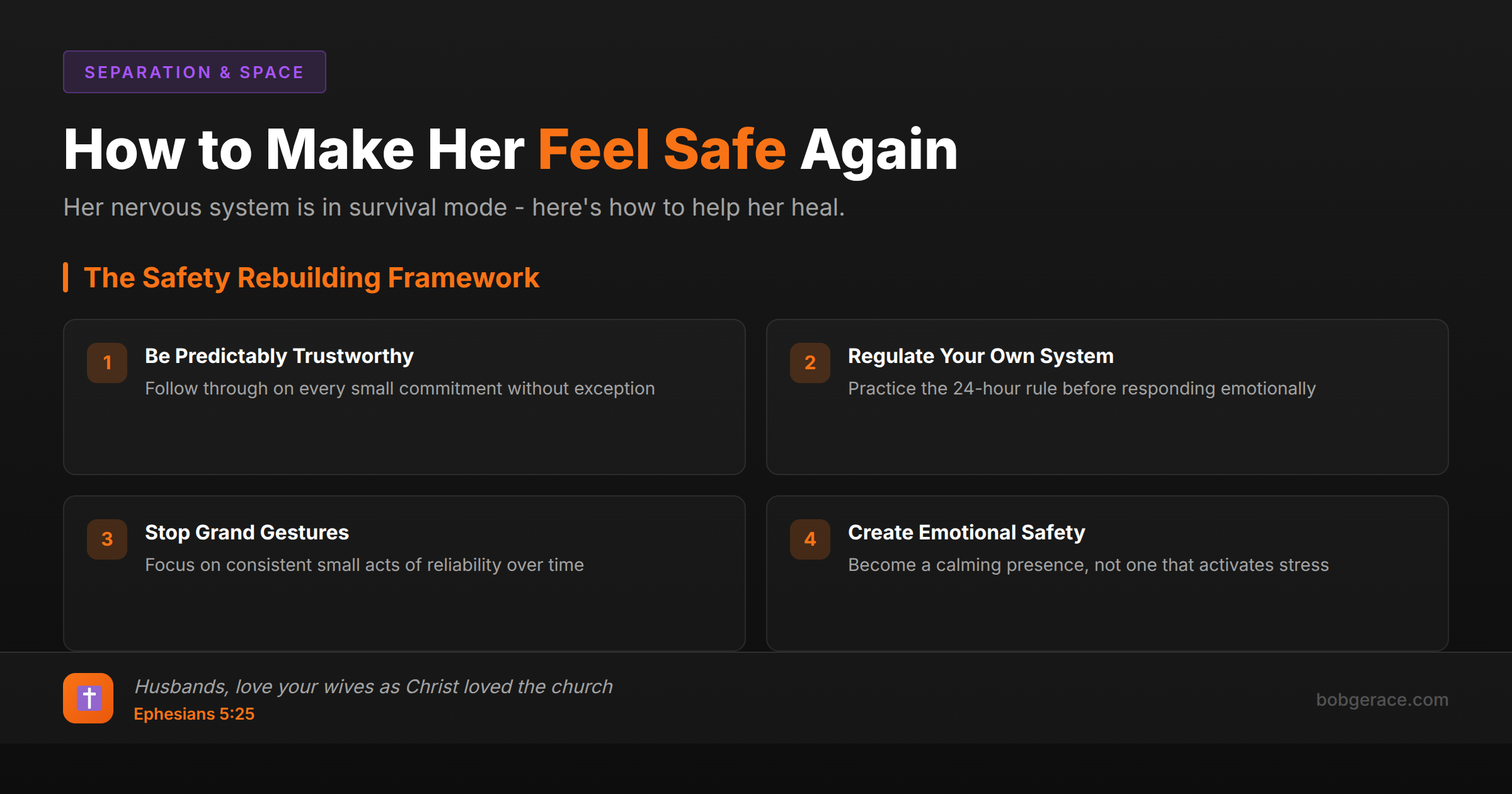
When your wife has checked out, her nervous system is essentially in survival mode. To help her feel safe again, you need to become predictably trustworthy rather than trying to prove yourself through grand gestures. Her brain needs to see consistent, small acts of reliability over time. This means following through on every commitment, no matter how small, and creating an environment where she never has to brace for emotional impact. Stop trying to rush her healing process and instead focus on becoming the kind of man whose presence naturally calms rather than activates her stress response. Safety isn't built through words or promises—it's built through sustained, predictable behavior that allows her nervous system to gradually downregulate from hypervigilance.
The Full Picture
When a woman's nervous system perceives her marriage as unsafe, it doesn't matter how much you love her or how badly you want to fix things. Her brain has shifted into protective mode, and logic won't override biology. Understanding this isn't about excusing behavior—it's about recognizing that healing requires a different approach than what most men instinctively try.
Your wife's nervous system has been shaped by patterns of interaction over months or years. Maybe there have been broken promises, emotional volatility, criticism, or simply the unpredictability that comes when someone is trying to manage your emotions instead of their own. Her brain has learned to stay alert around you, which is exhausting and ultimately leads to disconnection as a protective mechanism.
The key insight: Safety isn't about the absence of conflict—it's about predictable, consistent responses that allow her nervous system to relax. When she can predict how you'll handle stress, disappointment, or difficult conversations, her brain doesn't have to stay in defensive mode.
This means the solution isn't about becoming perfect or never having problems. It's about becoming steady. It's about developing the internal regulation that allows you to respond rather than react, especially when things don't go your way. When her nervous system recognizes that you're not going to explode, withdraw, blame, or manipulate when faced with challenges, it can begin to downregulate.
The hardest part for most men is accepting that this process takes time and can't be rushed. Your wife's nervous system didn't become dysregulated overnight, and it won't heal overnight. But when you focus on becoming genuinely safe rather than just trying to appear safe, real healing becomes possible.
What's Really Happening
From a neurobiological perspective, when a woman has 'checked out' of her marriage, we're often seeing the result of chronic nervous system activation. The brain's threat detection system—primarily the amygdala—has learned to associate the marriage relationship with potential danger, even if that danger is emotional rather than physical.
This creates what we call 'neuroception'—the unconscious detection of safety or threat. Her nervous system is constantly scanning for cues that indicate whether it's safe to be emotionally available or whether it needs to remain protected. When the neuroception consistently detects threat, the nervous system shifts into a dorsal vagal shutdown, which manifests as emotional withdrawal, numbness, or 'checking out.'
The pathway back to safety requires consistent co-regulation experiences. This means her nervous system needs to have repeated experiences of your nervous system being calm and regulated, especially during moments of stress or conflict. Mirror neurons in her brain will pick up on your internal state, and over time, this can help her system remember what safety feels like.
Crucially, this isn't about suppressing your emotions or becoming emotionally flat. It's about developing genuine self-regulation—the ability to feel your emotions without being controlled by them. When you can remain present and responsive (rather than reactive) during difficult moments, you're providing the kind of consistent co-regulation that allows healing. The research shows this process typically takes 6-12 months of consistent behavior change before significant nervous system shifts occur.
What Scripture Says
Scripture provides a clear framework for creating the kind of safety that allows relationships to flourish. God's design for marriage includes the husband's role as a source of security and stability.
Ephesians 5:25-28 calls husbands to love their wives 'as Christ loved the church and gave himself up for her.' This isn't just about sacrifice—it's about the kind of consistent, self-giving love that creates safety. Christ's love is predictable, unwavering, and focused on the beloved's wellbeing rather than his own comfort.
1 Peter 3:7 instructs husbands to 'live with your wives in an understanding way, showing honor to the woman as the weaker vessel, since they are heirs with you of the grace of life.' The word 'understanding' here implies careful attention to her inner world and emotional needs, including her need for safety.
Proverbs 31:11 describes a wife whose 'heart safely trusts' in her husband. This safety isn't automatic—it's cultivated through faithful, consistent character. When a woman's heart safely trusts, it means her nervous system has learned that her husband is a source of security rather than threat.
James 1:19 provides practical guidance: 'Be quick to hear, slow to speak, slow to anger.' This creates the kind of predictable, non-threatening environment where emotional safety can develop. When your wife knows you won't immediately react with defensiveness or anger, her nervous system can remain calm during difficult conversations.
Galatians 5:22-23 describes the fruit of the Spirit, including self-control, gentleness, and faithfulness—all qualities that create nervous system safety. These aren't just moral virtues; they're the character traits that allow another person's nervous system to relax in your presence.
What To Do Right Now
-
1
Stop trying to convince her you've changed and instead focus on actually changing. Your nervous system regulation needs to become automatic, not performative.
-
2
Keep every small commitment without exception. If you say you'll take out the trash, call at a specific time, or handle a task, do it exactly when you said you would.
-
3
Practice the 24-hour rule before responding to anything emotionally charged. This shows her brain you're no longer reactive and unpredictable.
-
4
Eliminate defensive responses completely. When she expresses concerns, your only job is to listen and understand, not to defend or explain.
-
5
Create predictable routines in your daily interactions. Consistent morning greetings, regular check-ins, and reliable bedtime routines all signal safety to her nervous system.
-
6
Work on your own emotional regulation through prayer, exercise, and possibly counseling. Her safety depends on your ability to remain calm under pressure.
Related Questions
- What signals threat to her nervous system?
- What do I do that activates her defense?
- What would help her ventral vagal (social engagement)?
- How do I co-regulate with someone who won't engage?
- How do I become a safe presence again?
- What does safety look like to her nervous system?
- What does 'holding space' actually mean?
- How do I become emotionally intelligent?
- What does emotional co-regulation look like?
- How do I become a safe emotional presence?
Also find Bob on
Subscribe for weekly videos on Christian marriage.
Your Marriage Needs More Than a Pattern
A coach who knows your specific situation can help you see what's actually landing with her—and what's still activating her system. You don't have to keep guessing alone.
Talk to Bob →