Why does my desire to talk make her withdraw more?
6 min read
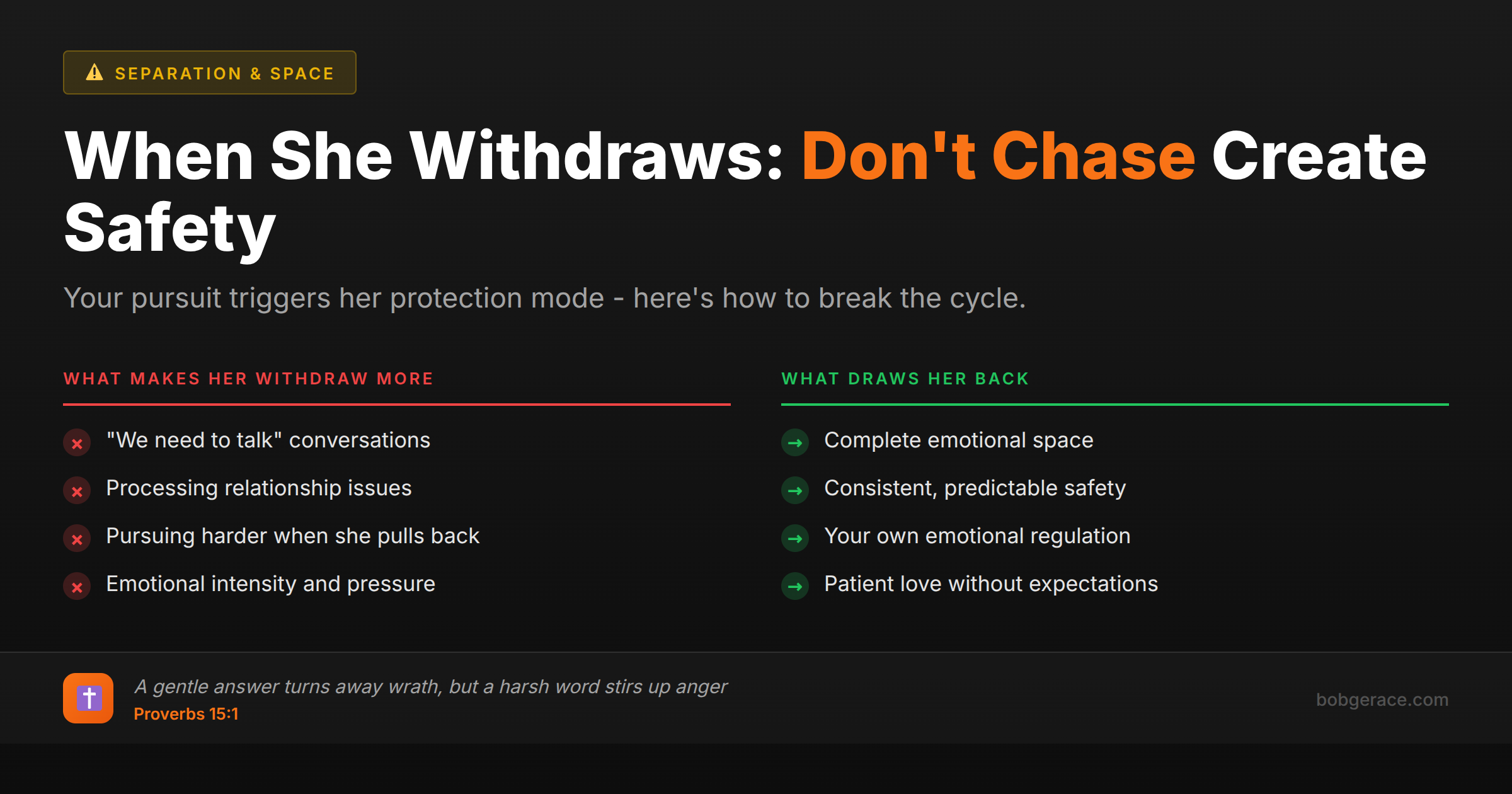
Your desire to talk triggers her withdrawal because you've likely entered the pursue-withdraw cycle - one of the most destructive patterns in marriage. When she's already emotionally overwhelmed or feeling criticized, your attempts to connect feel like pressure rather than love. Her brain interprets your pursuit as a threat to her emotional safety, activating her nervous system's protective response to create distance. This isn't about you being wrong for wanting connection or her being wrong for needing space. It's about mismatched attachment responses creating a negative feedback loop. The more you pursue, the more unsafe she feels. The more she withdraws, the more abandoned you feel, driving you to pursue harder. Understanding this cycle is the first step to breaking it and creating the safety she needs to move toward you again.
The Full Picture
The pursue-withdraw cycle is like an emotional dance where both partners are stepping on each other's toes, but neither realizes they're doing it. When your wife has checked out emotionally, her nervous system is already in a protective state. She's not thinking clearly about connection - she's in survival mode, trying to preserve what little emotional energy she has left.
Here's what's happening in her world: Every attempt you make to talk feels like an emotional demand she can't meet. She's already running on empty, and your desire for connection - no matter how loving your intention - registers as pressure. Her brain says, "I can't handle one more thing right now," and she instinctively creates more distance to protect herself.
Meanwhile, in your world: You're watching your wife slip away and your natural response is to reach for her. You want to understand, to fix, to reconnect. But every time you reach out, she steps back, which triggers your own attachment fears. You feel rejected, abandoned, and desperate to bridge the gap, so you try harder.
This creates what therapists call "negative sentiment override" - where even positive gestures get interpreted negatively because the emotional environment is already contaminated. Your "Can we please just talk?" sounds like love to you, but it sounds like demand and criticism to her overwhelmed nervous system.
The tragedy is that you both want the same thing - connection and safety - but your strategies for getting it are canceling each other out. You're pursuing connection through talking and engagement. She's pursuing safety through space and withdrawal. Neither strategy is wrong, but they're incompatible when executed simultaneously.
The good news? This cycle can be broken, but it requires you to make the first move by changing your approach entirely.
What's Really Happening
From an attachment perspective, what you're experiencing is a classic anxious-avoidant dynamic under stress. When your wife has emotionally checked out, she's operating from what we call a 'deactivated attachment system.' Her emotional regulation capacity is compromised, and her brain is prioritizing self-preservation over connection.
Neurologically, her amygdala - the brain's alarm system - is hypervigilant to any perceived emotional demands. Your attempts to talk trigger what feels like a threat response because her nervous system can't differentiate between your loving intention and emotional pressure. She's not choosing to be difficult; her brain is automatically protecting her from what feels like emotional overwhelm.
This is compounded by what often happens in distressed marriages: a history of conversations that haven't felt safe for her. If previous attempts to talk have involved criticism, defensiveness, or feeling unheard, her brain has learned to associate 'we need to talk' with emotional pain. Even if you've changed your approach, her nervous system still carries that protective programming.
The pursue-withdraw cycle becomes self-reinforcing because it confirms both partners' deepest fears. Your pursuit confirms her fear that she can't have autonomy and space. Her withdrawal confirms your fear that she doesn't want connection with you. Both responses escalate the very behaviors that triggered them in the first place.
Breaking this cycle requires what we call 'differentiated responding' - the ability to act based on your values rather than react to your emotions. This means learning to provide safety and space first, which paradoxically creates the conditions where she can eventually move toward connection again.
What Scripture Says
Scripture gives us profound wisdom about how to love someone who's withdrawn and overwhelmed. God's approach to us when we're distant isn't to pursue harder, but to demonstrate consistent, patient love that draws us back to safety.
"A gentle answer turns away wrath, but a harsh word stirs up anger." (Proverbs 15:1) When someone is already overwhelmed, even your good intentions can feel harsh if they're delivered with emotional intensity. Gentleness isn't weakness - it's strength under control, creating safety for someone whose emotional defenses are already up.
"Be completely humble and gentle; be patient, bearing with one another in love." (Ephesians 4:2) This verse captures the heart of what your wife needs right now. Humility means recognizing that your desire to talk, while valid, may not be what serves her best in this moment. Patience means giving her the time and space she needs to feel safe enough to engage.
"Above all, love each other deeply, because love covers over a multitude of sins." (1 Peter 4:8) Deep love isn't just emotional intensity - it's love that goes beneath the surface behaviors to understand the heart. Your wife's withdrawal isn't a sin against you; it's a protection mechanism. Love that covers means you respond to her heart need for safety rather than reacting to her surface behavior.
"The Lord is compassionate and gracious, slow to anger, abounding in love." (Psalm 103:8) This is your model for loving a withdrawn spouse. God doesn't pressure us into relationship when we're struggling. He remains consistently available, patient, and kind until we're ready to draw near again.
"Come to me, all you who are weary and burdened, and I will give you rest." (Matthew 11:28) Jesus' invitation is the opposite of pressure - it's an offer of rest and relief. Your wife is weary and burdened. She needs you to become a place of rest rather than another source of emotional labor.
"A man's heart plans his way, but the Lord directs his steps." (Proverbs 16:9) Your plan might be to reconnect through talking, but God may be directing you toward a different path - one that serves her heart and ultimately serves your marriage better.
What To Do Right Now
-
1
Stop all pursuit immediately - No more 'we need to talk' conversations, processing requests, or attempts to discuss the relationship. Give her complete emotional space.
-
2
Focus on your own emotional regulation - Work with a counselor, coach, or mentor to understand your attachment fears and develop healthier ways to manage your anxiety about the relationship.
-
3
Become consistently safe and predictable - Show up with steady kindness, reliability, and emotional stability without expecting anything in return. Let your actions speak louder than words.
-
4
Address any underlying issues she's raised - If she's mentioned specific problems or grievances, work on those independently without asking her to affirm your progress or re-engage with you.
-
5
Create positive, low-pressure interactions - Engage in activities you both enjoy without any agenda to 'work on the marriage.' Let her experience you as a source of lightness rather than intensity.
-
6
Pray consistently for her heart and your own - Ask God to heal whatever wounds have created this dynamic and to give you wisdom, patience, and the right timing for any future conversations.
Related Questions
- What is 'stonewalling' and why does she do it?
- What is the 'pursuer-distancer' dynamic?
- Why does my instinct to pursue backfire?
- How do I pursue without pressuring?
- What does 'emotional flooding' feel like for her?
- What's the difference between presence and pressure?
- Why do I rage at the people I love?
- What is anxious attachment and am I doing it right now?
- How do I listen without fixing?
- What does 'protest behavior' look like and am I doing it?
Also find Bob on
Subscribe for weekly videos on Christian marriage.
Your Marriage Isn't a Textbook Case
The pursue-withdraw cycle plays out differently in every relationship. A coach who knows your specific dynamic can help you see what's actually happening between you two—and what to do about it.
Talk to Bob →