How do attachment injuries from childhood show up now?
5 min read
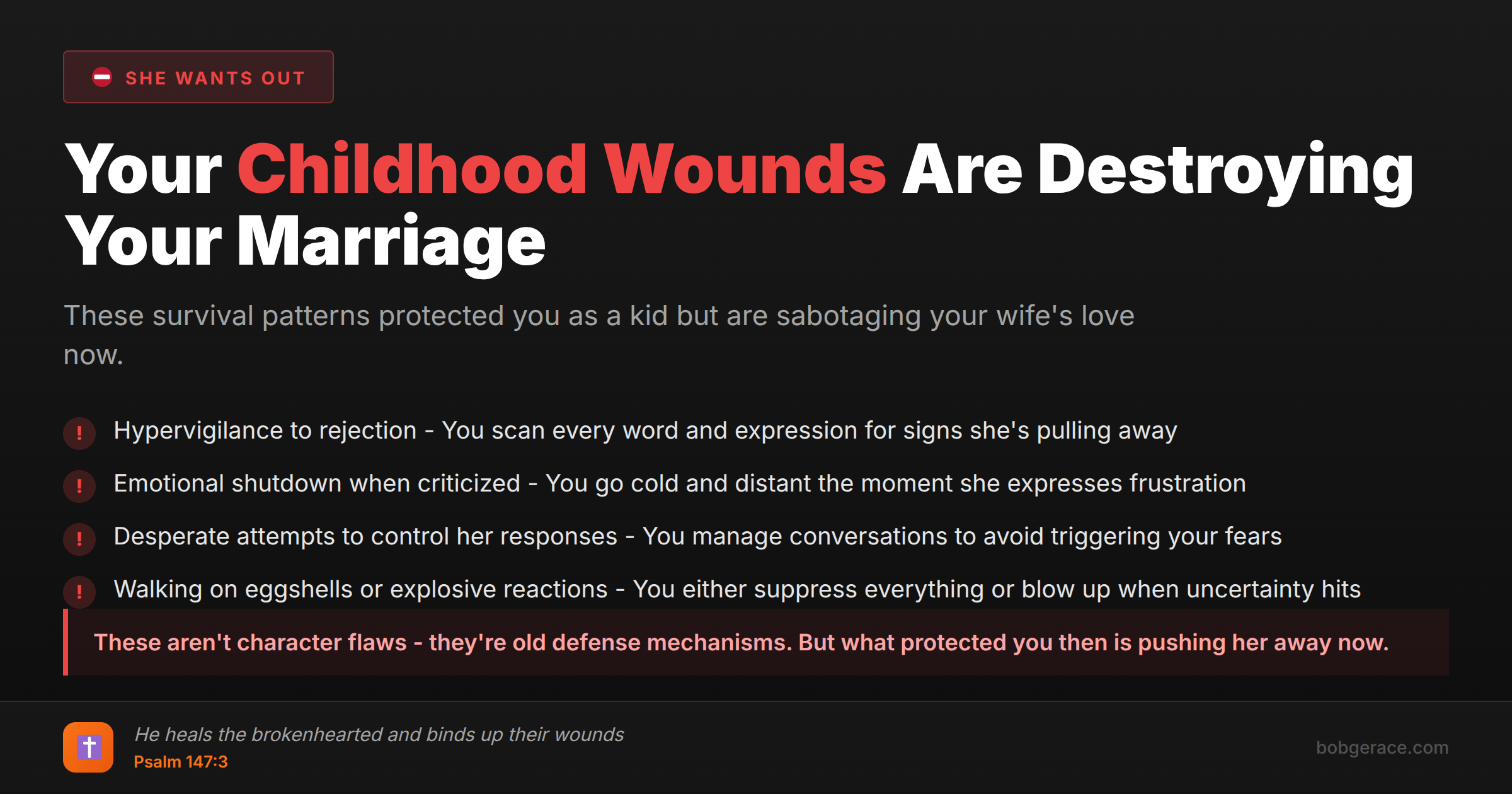
Your childhood attachment injuries are likely showing up in your marriage as hypervigilance to rejection, emotional shutdown when criticized, or desperate attempts to control your wife's responses. If you had an absent father, you might chase your wife's approval obsessively. If your mother was unpredictable, you might walk on eggshells or explode when things feel uncertain. These aren't character flaws - they're survival strategies your young brain developed to cope with emotional wounds. But what protected you as a child is now sabotaging your marriage. Your wife isn't rejecting the real you; she's responding to these old defense mechanisms that make intimacy feel unsafe for both of you.
The Full Picture
Attachment injuries are the emotional wounds created when our primary caregivers couldn't provide consistent safety, comfort, or connection. Maybe your dad was physically present but emotionally unavailable. Perhaps your mom was loving but anxious, making you responsible for managing her emotions. These experiences wire our nervous system for specific threat responses that activate automatically in marriage.
The most common patterns I see:
• The Anxious Pursuer - You experienced inconsistent love, so now you monitor your wife's every mood, text constantly when apart, and interpret her need for space as rejection • The Avoidant Defender - You learned early that emotions weren't safe, so you shut down during conflict, minimize problems, or escape into work, hobbies, or screens • The Controller - Chaos or neglect taught you that safety comes from control, so you micromanage household decisions, get angry when plans change, or use logic to dismiss her emotions • The People-Pleaser - You learned love was conditional on performance, so you say yes to everything, avoid conflict at all costs, and lose yourself trying to keep her happy
Here's what's crucial to understand: these responses happen in your brainstem before conscious thought. When your wife expresses frustration, your attachment system scans for familiar threats. If criticism meant abandonment in childhood, her feedback triggers the same fight-or-flight response you'd have to a physical attack.
Your wife isn't trying to hurt you, but she's likely responding to your attachment responses rather than connecting with who you really are. When you pursue anxiously, she feels suffocated. When you shut down, she feels abandoned. When you control, she feels trapped. This creates a negative cycle where both of you are defending against threats that aren't actually there.
What's Really Happening
Attachment theory shows us that our earliest relationships create internal working models of self and others that guide adult relationships. Research by Bowlby, Ainsworth, and others demonstrates that childhood attachment injuries literally shape brain development, particularly in regions responsible for emotional regulation and threat detection.
When attachment needs weren't met consistently, the nervous system develops hypervigilance to relational threats. The amygdala becomes oversensitive to signs of rejection, criticism, or abandonment. Meanwhile, the prefrontal cortex - responsible for rational thought and emotional regulation - goes offline during triggered states. This is why you might say or do things during marital conflict that you later regret.
Neuroplasticity research offers hope: the brain remains changeable throughout life. New relational experiences can literally rewire neural pathways. However, this requires conscious effort to recognize triggers, pause automatic responses, and choose new behaviors repeatedly until they become natural.
Adult Attachment Interview studies show that individuals who've processed their childhood experiences - even traumatic ones - can develop 'earned secure' attachment. This means your past doesn't determine your future, but healing requires facing these wounds with compassion rather than shame.
The key clinical insight: your attachment responses aren't pathology - they're adaptations. A child who learned to scan for danger, avoid conflict, or caretake others was surviving their environment. The problem arises when these strategies persist in adult relationships where safety and mutuality are possible. Recognizing this can shift self-criticism into self-compassion, which is essential for change.
What Scripture Says
Scripture acknowledges that childhood experiences profoundly impact our adult lives. Proverbs 22:6 reminds us, "Train up a child in the way he should go; even when he is old he will not depart from it." This applies not just to positive training, but to painful patterns learned in broken families.
God understands our wounds and offers healing. Psalm 147:3 promises, "He heals the brokenhearted and binds up their wounds." Notice it doesn't say He ignores our wounds or expects us to just get over them. Healing is an active process that God participates in with us.
Jesus Himself experienced attachment wounds. Isaiah 53:3 describes Him as "despised and rejected by men, a man of sorrows and acquainted with grief." He understands what it feels like to be misunderstood, abandoned, and hurt by those closest to Him. This isn't a distant God - this is One who knows our pain intimately.
We're called to transformation, not just behavior modification. Romans 12:2 says, "Do not be conformed to this world, but be transformed by the renewal of your mind." This renewal includes healing the wounded parts of our thinking and responding that developed in childhood.
Ephesians 4:15-16 calls us to "grow up in every way into him who is the head, into Christ." This growth happens in relationship - "when each part is working properly, makes the body grow so that it builds itself up in love." Your marriage can become part of God's healing process as you learn to give and receive love in healthier ways.
Finally, 2 Corinthians 5:17 reminds us that "if anyone is in Christ, he is a new creation. The old has passed away; behold, the new has come." This doesn't mean your past disappears, but that God can redeem even your deepest wounds for His purposes and your good.
What To Do Right Now
-
1
Identify your primary attachment response pattern by honestly assessing how you typically react when feeling threatened in your marriage
-
2
Notice your body's early warning signs of activation - tension, shallow breathing, racing thoughts - before you react automatically
-
3
Practice the pause by taking three deep breaths and asking 'What am I really afraid of right now?' when triggered
-
4
Share your attachment history with your wife without making it her responsibility to fix or accommodate your triggers
-
5
Develop a specific phrase to use when activated, such as 'I'm feeling triggered by something from my past, give me a moment'
-
6
Seek professional help from a therapist trained in attachment work to process deeper childhood wounds safely
Related Questions
- What is anxious attachment and am I doing it right now?
- She seems cold and detached — is that avoidant attachment?
- Why does my pursuing make her pull away more?
- What's the pursue-withdraw cycle and how do I stop it?
- What does 'protest behavior' look like and am I doing it?
- I'm panicking and want to pursue her — is that my attachment style?
- What attachment injuries did I experience?
- How do childhood attachment wounds show up in marriage?
- What is 'internal working model' and how do I change mine?
- What are 'attachment injuries' and how many did I cause?
Also find Bob on
Subscribe for weekly videos on Christian marriage.
Your History Isn't Your Fate
These patterns are specific to your story. A coach who knows your marriage can help you see where the old wiring is running the show—and what to do instead.
Talk to Bob →