How do I hold tension without collapsing or attacking?
5 min read
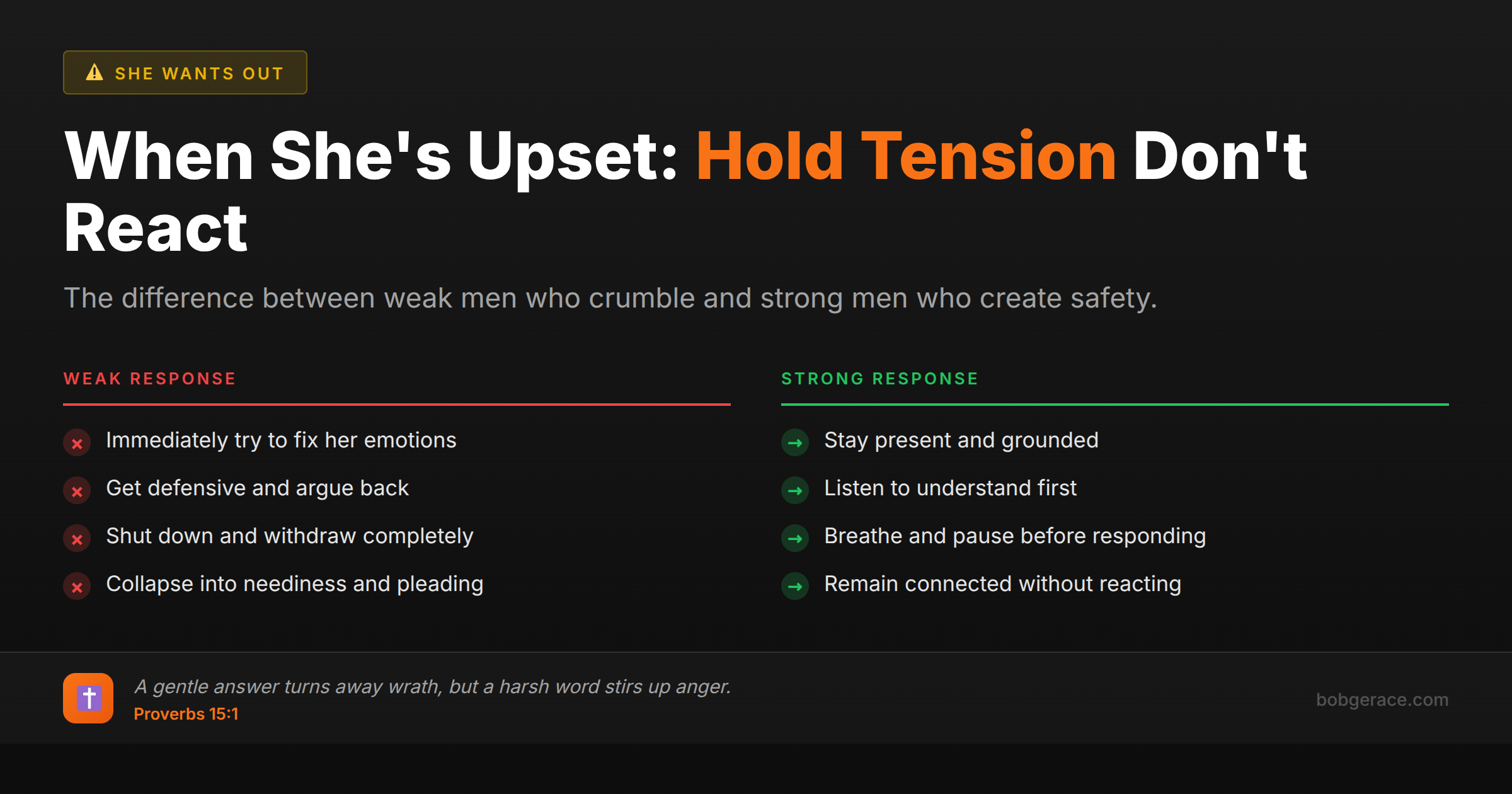
Holding tension means staying present and grounded when your wife is upset, critical, or pulling away - without either crumbling into neediness or lashing out in anger. It's about becoming the steady, unshakeable man she can trust with her emotions, even the difficult ones. This isn't about being stoic or emotionless. It's about developing the internal strength to remain connected to yourself and to her, even when everything in you wants to either fix it immediately or defend yourself. When you can hold space for tension without collapsing into anxiety or exploding into anger, you create safety for real intimacy to grow.
The Full Picture
Most men have never learned to hold emotional tension. We've been trained to either fix problems immediately or defend ourselves when criticized. Neither response works in marriage because both rob your wife of feeling truly seen and heard.
When your wife expresses frustration, disappointment, or pulls away, your nervous system likely goes into overdrive. You either:
• Collapse - Become anxious, apologetic, people-pleasing, desperate to make it better • Attack - Get defensive, argumentative, critical, or shut down emotionally
Both responses communicate the same message: "I can't handle you when you're upset." This makes her feel alone with her emotions and pushes her further away.
Holding tension means staying regulated while she's dysregulated. It means your emotional state isn't dependent on hers. When she's angry, you don't automatically become angry back. When she's disappointed, you don't spiral into shame and self-attack.
This doesn't mean you become a robot. You can acknowledge her emotions, express empathy, and even share your own feelings - but from a grounded, centered place rather than reactive desperation or defensiveness.
Think of it like being a lighthouse in a storm. The waves crash against you, but you remain steady, providing a beacon of safety. Your wife needs to know she can bring her full emotional experience to you without destabilizing the relationship.
What's Really Happening
From a neurobiological perspective, what we call "holding tension" is actually nervous system regulation under stress. When couples argue, both partners' sympathetic nervous systems activate - triggering fight, flight, or freeze responses.
Research by Dr. John Gottman shows that when men's heart rates exceed 100 BPM during conflict, they become physiologically flooded and lose access to higher-order thinking. This flooding leads to either defensive aggression or emotional withdrawal - both relationship killers.
The key is developing distress tolerance - the ability to experience uncomfortable emotions without immediately acting to eliminate them. This skill comes from strengthening your parasympathetic nervous system through practices like deep breathing, mindfulness, and somatic awareness.
Attachment theory helps us understand why this matters so much to women. Many women have anxious attachment patterns and need consistent emotional regulation from their partners to feel safe. When you collapse or attack, you're confirming her deepest fear: that she's too much for you to handle.
Neuroplasticity research shows us that these patterns can change. Through consistent practice, you can literally rewire your brain's response to emotional stress. The goal isn't to eliminate emotional reactions, but to create space between stimulus and response - what Viktor Frankl called "man's last freedom."
This work requires understanding your own triggers, developing somatic awareness of your nervous system states, and practicing regulation techniques consistently, not just during conflicts.
What Scripture Says
Scripture calls us to be men who can handle life's tensions with wisdom and strength. Proverbs 27:14 reminds us that "A gentle answer turns away wrath, but a harsh word stirs up anger." This isn't about being passive - it's about responding from strength rather than reacting from weakness.
James 1:19-20 instructs us to "be quick to listen, slow to speak and slow to become angry, because human anger does not produce the righteousness that God desires." This passage describes exactly what holding tension looks like - creating space between what we hear and how we respond.
Jesus himself modeled this perfectly. In John 8:6-7, when the religious leaders brought the adulteress to him, he didn't react defensively or attack them back. Instead, he knelt down, wrote in the sand, and then responded with wisdom and grace. He held the tension of their accusations without collapsing under pressure or attacking in return.
1 Peter 3:7 calls husbands to "live with your wives in an understanding way, showing honor to the woman as the weaker vessel, since they are heirs with you of the grace of life." This doesn't mean women are inferior - it means we're called to be the stronger vessel emotionally, able to hold space for their full experience.
Ephesians 4:26 says "In your anger do not sin." Notice it doesn't say don't get angry - it says don't sin in your anger. You can feel emotions fully without letting them drive destructive behavior. This is the essence of holding tension - feeling everything while choosing your response wisely.
What To Do Right Now
-
1
Practice box breathing daily: 4 counts in, 4 hold, 4 out, 4 hold, for 2 minutes minimum
-
2
Notice your physical sensations when tension arises - tight chest, clenched jaw, shallow breathing
-
3
Create a pause phrase like 'Let me think about that' instead of reacting immediately
-
4
Ground yourself by feeling your feet on the floor and taking three deep breaths before responding
-
5
Listen to understand rather than defend - repeat back what you heard before sharing your perspective
-
6
Practice saying 'I can see you're really upset' without trying to fix or defend anything
Related Questions
- What is 'differentiation' and why does it matter now?
- What's the difference between presence and pressure?
- How do I show love without activating her withdrawal?
- How do I fight without pushing her away?
- What's the difference between pursuing and chasing?
- How do I stay grounded when everything feels adversarial?
- How do I not lose my mind right now?
- How do I stop exploding?
- What is 'window of tolerance' and how do I widen mine?
- How do I be strong and gentle?
Also find Bob on
Subscribe for weekly videos on Christian marriage.
You Don't Have to Figure This Out Alone
Holding tension in your actual marriage—with her specific triggers, your specific patterns—requires more than concepts. A coach who knows your story can help you stay grounded when it counts.
Talk to Bob →