How do I know if this is trauma response or true clarity?
5 min read
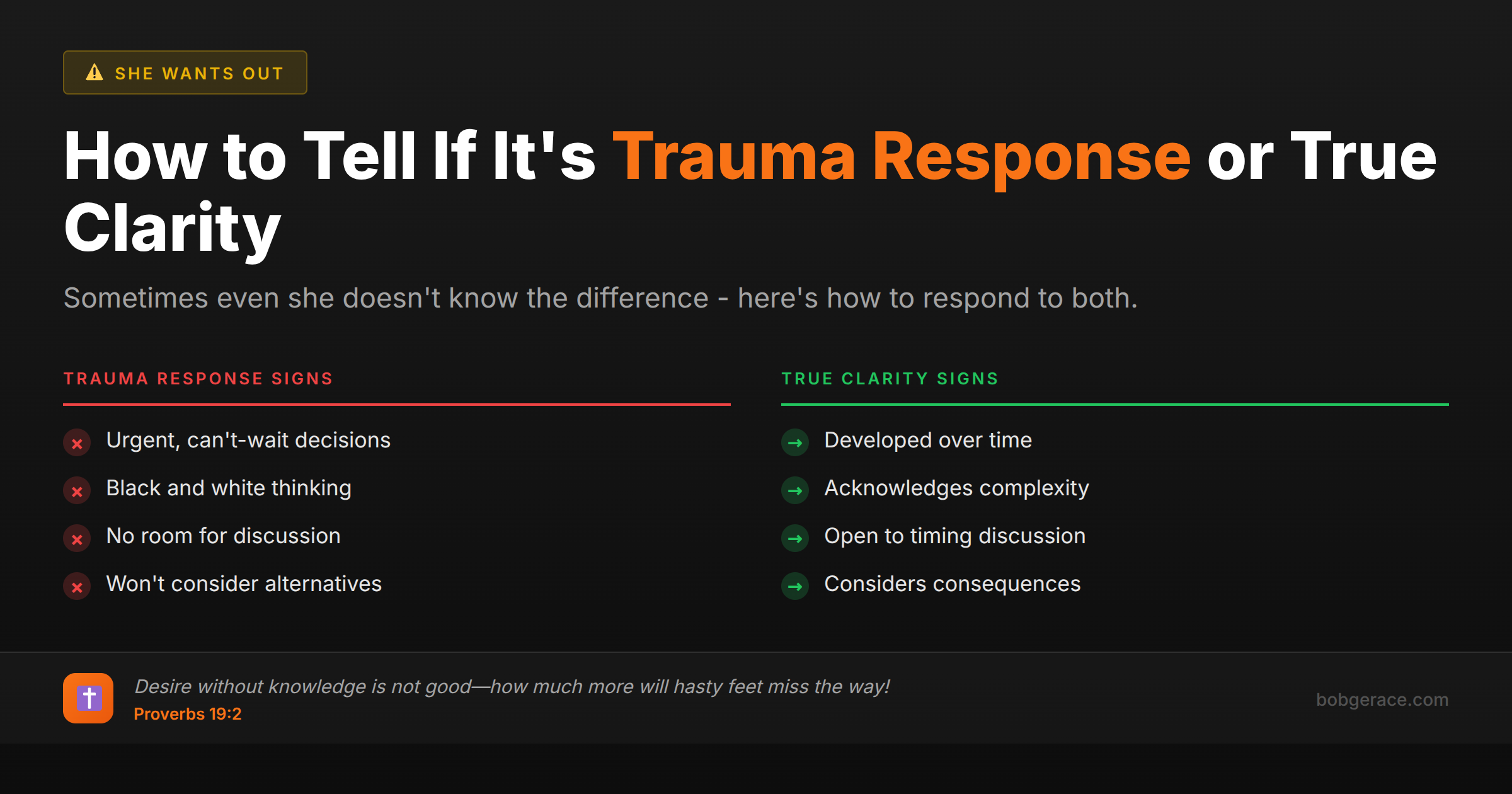
This is one of the hardest questions you'll face, and honestly, sometimes even she doesn't know. Trauma responses often feel crystal clear to the person experiencing them - that's what makes them so convincing. But here's what I've learned after working with hundreds of men: trauma-driven decisions typically come with urgency, black-and-white thinking, and an inability to consider alternatives or timing. True clarity, on the other hand, usually develops over time and includes acknowledgment of complexity, consideration of consequences, and openness to discussion about timing and process. The key isn't trying to diagnose her mental state - that's not your job. The key is understanding what you're actually dealing with so you can respond appropriately.
The Full Picture
The challenge is that both trauma responses and genuine clarity can look identical from the outside. Your wife might seem absolutely certain either way. She might have compelling reasons either way. The difference lies in the underlying process and patterns.
Trauma responses typically show these characteristics: • Sudden shifts - The decision seems to come out of nowhere or after a triggering event • All-or-nothing thinking - No middle ground, no willingness to consider alternatives • Urgency without clear reason - Everything has to happen immediately • Disconnection from consequences - Seems unable to fully process what this means for kids, finances, future • Resistance to any input - Won't consider counseling, waiting, or outside perspectives • Emotional dysregulation - Extreme reactions to normal conversations about the decision
True clarity usually includes: • Gradual development - The decision has been building over time with identifiable factors • Acknowledgment of complexity - Recognizes this is hard and affects everyone • Consideration of timing - Willing to discuss how and when, not just that it's happening • Openness to process - May be willing to do counseling to ensure it's the right choice • Emotional regulation - Can discuss it without extreme reactions • Awareness of impact - Clearly understands consequences for family
Here's what complicates everything: trauma and clarity can coexist. She might have trauma responses to your marriage AND genuine clarity about wanting out. Or she might have genuine concerns about your relationship AND be processing them through a trauma lens that's distorting her perception.
The most important thing to understand: arguing about whether it's trauma or clarity is counterproductive. Your job isn't to diagnose her mental state. Your job is to respond in a way that addresses both possibilities - creating safety for trauma healing while also taking her concerns seriously.
What's Really Happening
From a clinical perspective, distinguishing between trauma responses and authentic decision-making requires understanding how trauma affects the nervous system and cognitive processing. When someone is in a trauma state, their prefrontal cortex - responsible for executive functioning, future planning, and nuanced thinking - goes offline. The limbic system takes over, prioritizing immediate safety over complex problem-solving.
Research shows that trauma responses create what we call 'cognitive narrowing.' The person can only see limited options, usually fight, flight, or freeze. In marriage, this might manifest as 'I have to leave immediately' (flight) or 'I have to fight for my independence' (fight) or emotional shutdown (freeze). These responses feel completely rational to the person experiencing them because their brain is genuinely perceiving threat.
However, authentic clarity engages the whole brain. The person can access both emotional awareness and logical reasoning. They can hold multiple perspectives simultaneously, consider long-term consequences, and remain open to new information. This doesn't mean the decision is any less firm - it means it's coming from a different neurological place.
Trauma-informed therapy recognizes that both can be true simultaneously. A woman might have legitimate concerns about her marriage AND be processing those concerns through a trauma-activated nervous system. The trauma isn't invalidating her concerns - it's affecting how she's able to process and respond to them.
The key clinical indicator is flexibility versus rigidity. Trauma responses tend toward rigid, absolute thinking. Authentic clarity maintains some degree of flexibility about process, timing, and approach, even when the core decision remains firm. This is why creating safety and reducing activation is crucial - it allows access to fuller cognitive and emotional resources for decision-making.
What Scripture Says
Scripture acknowledges both the reality of wounds that affect our thinking and the importance of wise decision-making. Proverbs 27:6 tells us, 'Wounds from a friend can be trusted, but an enemy multiplies kisses.' This reminds us that hurt people don't always see clearly - wounds affect perception and judgment.
Proverbs 19:2 warns, 'Desire without knowledge is not good—how much more will hasty feet miss the way!' This speaks directly to decisions made in emotional urgency without full consideration. When trauma is driving decisions, there's often this quality of haste that Scripture cautions against.
However, Scripture also validates the reality of genuine discernment. Philippians 1:9-10 says, 'And this is my prayer: that your love may abound more and more in knowledge and depth of insight, so that you may be able to discern what is best and may be pure and blameless for the day of Christ.' True clarity comes with this quality of discernment that considers multiple factors.
1 Corinthians 13:11 reminds us, 'When I was a child, I talked like a child, I thought like a child, I reasoned like a child. When I became a man, I put the ways of childhood behind me.' Trauma often pulls us back into childlike thinking - black and white, immediate, emotional. Maturity includes the ability to hold complexity.
James 1:5 offers hope: 'If any of you lacks wisdom, you should ask God, who gives generously to all without finding fault, and it will be given to you.' Whether this is trauma or clarity, both of you need divine wisdom to navigate it well.
Most importantly, Ephesians 4:26-27 instructs, 'In your anger do not sin: Do not let the sun go down while you are still angry, and do not give the devil a foothold.' Unprocessed wounds create footholds for destructive thinking. Your response should create space for healing, not additional wounding.
What To Do Right Now
-
1
Stop trying to convince her whether it's trauma or clarity - focus on creating emotional safety instead
-
2
Document patterns you're observing without labeling them as right or wrong
-
3
Suggest professional help framed as 'making sure we're both thinking clearly during this major decision'
-
4
Address any legitimate concerns she's raised regardless of how she's processing them
-
5
Remove pressure and urgency from conversations - trauma thrives on pressure
-
6
Seek your own counseling to process this situation with professional guidance
Related Questions
- Is she triggered or is this a rational decision?
- What does 'survival brain' look like in her right now?
- Is her leaving connected to past trauma?
- What is 'stacked trauma' and does she have it?
- What's the difference between trauma-driven leaving and conscious uncoupling?
- Did I retraumatize her without knowing?
- What is 'betrayal trauma' and do I have it?
- What does betrayal do to the brain?
- What is the 'trauma loop' and how do I interrupt it?
- What does trauma recovery look like?
Also find Bob on
Subscribe for weekly videos on Christian marriage.
Bring Your Specific Situation to Bob
You're reading concepts. A coach sees your actual marriage — what she's said, how long this has been building, what you're missing. You don't have to keep guessing alone.
Talk to Bob →