How do I respond to divorce papers?
6 min read
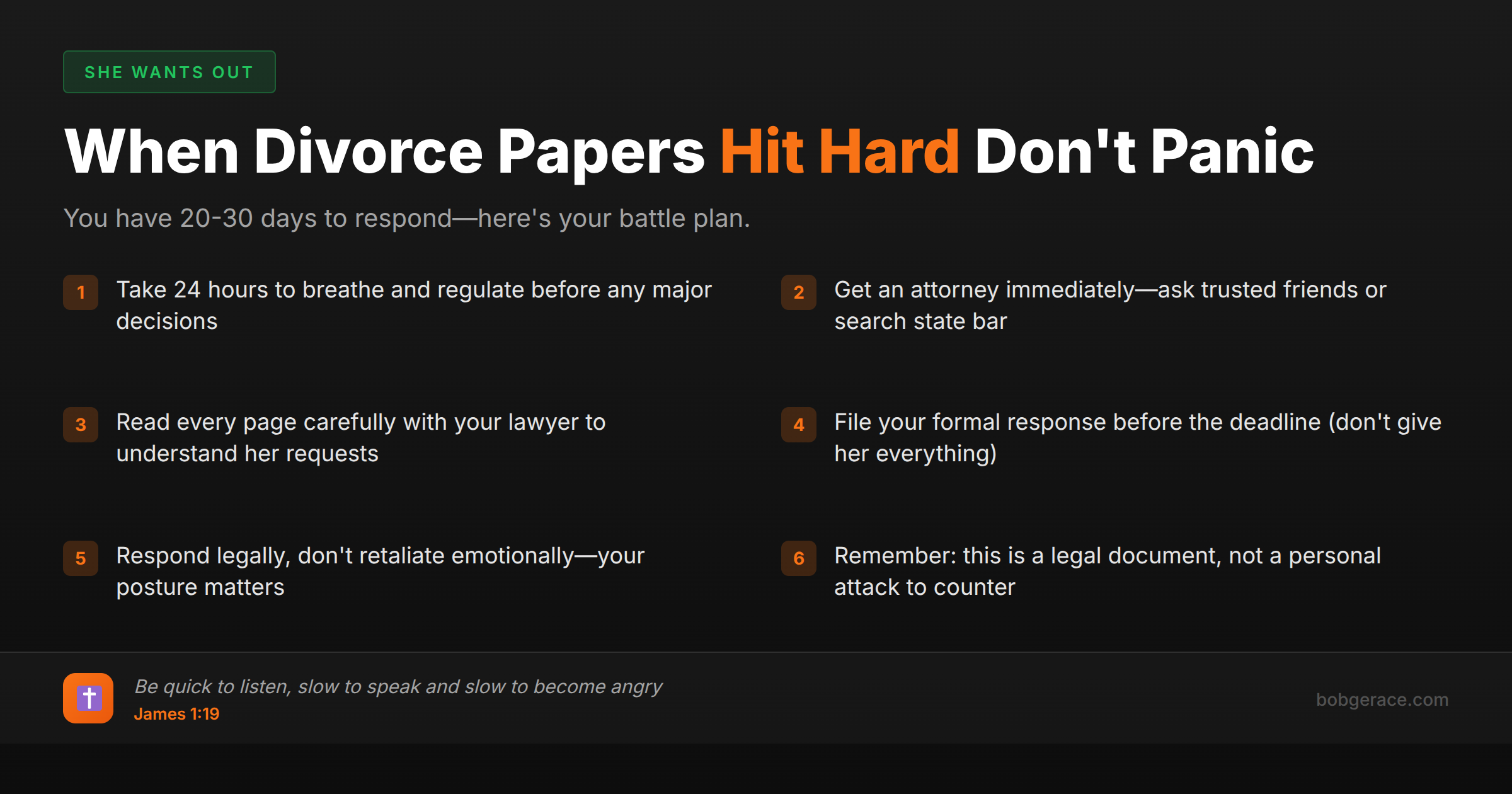
First, breathe. I know your world just got turned upside down, but your response in the next 30 days will impact everything that follows. You have both legal and relational decisions to make, and they're not mutually exclusive. Legally, you must respond within the timeframe specified (usually 30 days) or risk losing your rights to contest anything. But relationally, this is also a moment of opportunity. Many men make the mistake of either panicking and begging, or immediately going into battle mode with lawyers. Neither serves your marriage or your future well. The key is responding with both wisdom and strength – protecting your rights while keeping the door open for reconciliation. This isn't about playing games or manipulation. It's about being the man your marriage needs, even in crisis.
The Full Picture
When divorce papers arrive, you're facing two parallel tracks: the legal process and the relational opportunity. Most men get tunnel vision and focus only on one, usually the legal side, which is understandable but limiting.
The Legal Reality: • You have a specific timeframe to respond (typically 30 days) • Failure to respond means automatic default judgment • Your response preserves your right to contest custody, property division, and support • You can respond without admitting fault or agreeing to divorce
The Relational Opportunity: Counterintuitively, divorce papers can be a wake-up call that catalyzes real change. I've seen marriages turn around after papers were filed because it finally got the husband's full attention. Your wife isn't necessarily done – she's often desperate and this feels like her only option to be heard.
Common Mistakes Men Make: • Panic mode: Begging, promising to change, emotional outbursts • War mode: Immediately hiring aggressive lawyers, threatening counter-suits • Denial mode: Ignoring the papers or minimizing the situation • Victim mode: Focusing on how unfair this is rather than what you can control
The most effective response combines legal protection with relational wisdom. You file your response to protect your rights while simultaneously demonstrating the changes she's been asking for. This isn't about manipulation – it's about finally becoming the husband and father your family needs, whether the marriage survives or not.
Remember: divorce papers are often the end result of years of unaddressed issues, not a sudden decision. Your wife has likely been emotionally divorcing you long before these papers arrived.
What's Really Happening
From a clinical perspective, divorce filing often represents what we call 'protest behavior' – a last-ditch attempt to get a partner's attention when all other efforts have failed. Research shows that many women file for divorce not because they want to end the marriage, but because they feel unheard and hopeless about change.
The trauma response you're experiencing is normal. When served with papers, men typically cycle through fight, flight, or freeze responses. The fight response leads to aggressive legal strategies. Flight manifests as avoidance or substance use. Freeze results in paralysis and inaction. None of these serve your long-term interests.
Neurologically, your brain is flooded with stress hormones that impair decision-making. This is why immediate major decisions (like hiring the most aggressive attorney) often backfire. Your prefrontal cortex – responsible for rational thinking – is compromised when you're in crisis mode.
Studies indicate that couples who use collaborative approaches during separation have higher reconciliation rates and better co-parenting relationships if they do divorce. The adversarial approach often creates irreparable damage to any remaining emotional connection.
Attachment theory explains why your wife may seem cold or distant now. She's likely employing emotional detachment as a protective mechanism. The more you pursue with the same behaviors that drove her away, the more she'll withdraw. This is why changing your approach – not just promising to change – is crucial.
The window for reconciliation isn't closed, but it requires demonstrating actual change, not just expressing regret about consequences.
What Scripture Says
Scripture provides clear guidance for navigating this crisis with both wisdom and faith. This isn't about proof-texting your way out of consequences, but about responding as a man of God.
Proverbs 27:14 reminds us: *'Blessing someone with a loud voice early in the morning will be counted as a curse to him.'* Your initial response matters tremendously. Desperate promises and emotional pleading, even with good intentions, often push your wife further away.
James 1:19 instructs: *'Let every person be quick to hear, slow to speak, slow to anger.'* This is exactly the opposite of how most men respond to divorce papers. Take time to truly hear what your wife has been trying to tell you through her actions.
Proverbs 15:1 teaches: *'A soft answer turns away wrath, but a harsh word stirs up anger.'* Going into battle mode with lawyers and threats will likely cement her decision. Responding with strength but not harshness keeps possibilities open.
1 Corinthians 7:12-16 addresses the believing spouse whose partner wants to leave: *'If the unbelieving partner separates, let it be so... Yet how do you know, wife, whether you will save your husband? Or how do you know, husband, whether you will save your wife?'* Paul acknowledges that sometimes separation happens, but maintains hope for restoration.
Matthew 7:3-5 calls us to examine ourselves first: *'Why do you see the speck in your brother's eye, but do not notice the log in your own eye?'* Before focusing on what your wife has done wrong, honestly assess your contributions to the marriage's breakdown.
Ephesians 5:25-28 sets the standard: *'Husbands, love your wives as Christ loved the church and gave himself up for her.'* This sacrificial love isn't contingent on her response – it's your calling regardless.
What To Do Right Now
-
1
Consult an attorney within 48 hours to understand your rights and file an appropriate response that preserves your options
-
2
Write down your wife's specific complaints about the marriage over the past 2 years – focus on patterns, not isolated incidents
-
3
Contact a marriage coach or counselor immediately, even if your wife won't join you – demonstrate you're serious about change
-
4
Avoid discussing the divorce with your wife for at least one week while you process and plan your approach
-
5
Create a written plan addressing her top three concerns with specific actions and timelines – not just promises
-
6
Begin implementing changes in your behavior immediately, especially around communication and emotional availability
Related Questions
- She filed for divorce — can I stop it?
- Should I get my own lawyer?
- Should I contest or cooperate?
- What leverage do I have and should I use it?
- How do I protect assets without being aggressive?
- When does legal strategy serve reconciliation vs. destroy it?
- What evidence should I secure?
- What do I do about finances immediately?
- What boundaries should I set?
- How do I discern God's will for my marriage?
Also find Bob on
Subscribe for weekly videos on Christian marriage.
Bring Your Actual Situation to Bob
Divorce papers change the timeline. A coach who knows your marriage can help you make the legal and relational moves that keep the door open while protecting your rights.
Talk to Bob →