She's already talked to a lawyer — what now?
6 min read
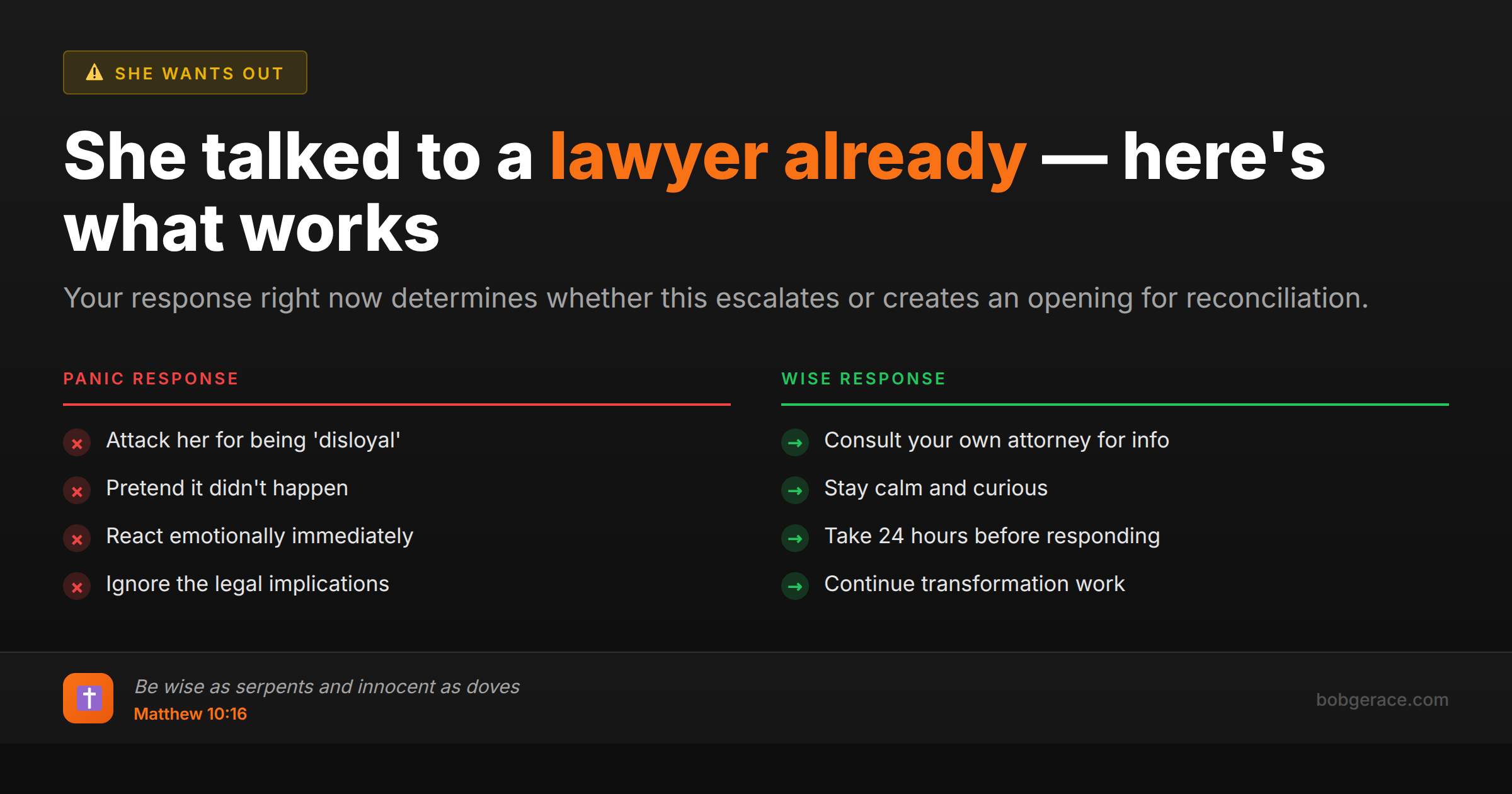
When your wife has talked to a lawyer, she's moved beyond thinking about divorce to actively preparing for it. This is crisis mode, but it's not game over. The fact that she consulted an attorney doesn't mean she's made her final decision – many people explore their options before committing to such a life-altering choice. Right now, your response matters more than ever. Panic, anger, or desperate pleading will only confirm her belief that divorce is the right path. Instead, you need to demonstrate the kind of man she fell in love with – calm, thoughtful, and capable of real change. This moment, as devastating as it feels, can become the turning point where you finally wake up to what's at stake and start fighting for your marriage with wisdom instead of desperation.
The Full Picture
When a wife consults a divorce attorney, she's crossed a psychological threshold. She's moved from "I'm unhappy" to "I'm planning my exit." This doesn't happen overnight – it's typically the result of months or years of feeling unheard, unloved, or hopeless about change.
Understanding her mindset is crucial: • She's likely already grieved the marriage in her mind • She's exploring practical questions: custody, finances, living arrangements • She's building confidence that she can survive without you • She may be documenting issues for potential custody considerations
Many men make critical mistakes at this stage. They become controlling (monitoring her activities, demanding passwords), desperate (grand gestures, love-bombing), or combative (threatening counter-suits, getting their own lawyer immediately). All of these responses confirm her worst fears about you.
Here's what most men don't understand: consulting a lawyer is often a woman's way of testing her own resolve. She's asking herself, "Am I really ready to blow up our family?" How you respond will heavily influence her answer.
Some wives will tell their husband about the consultation – either as a wake-up call or because they want to be honest about where things stand. Others will keep it private while they process their feelings. Either way, this is your last clear warning that immediate, substantial change is required.
The window for half-measures has closed. Surface-level improvements won't cut it anymore. She needs to see evidence that you're capable of becoming the man and husband she's needed all along – not just temporarily, but permanently.
What's Really Happening
From a clinical perspective, when a spouse consults a divorce attorney, they've typically moved through what we call the "cascade of disconnection." Dr. John Gottman's research shows that by this stage, the wife has likely experienced chronic emotional flooding, developed negative sentiment override, and begun the process of emotional detachment.
Neurologically, her brain has shifted into a protective mode. The neural pathways associated with love and attachment have been dampened by repeated experiences of disappointment or conflict. This is why logical arguments about saving the marriage often fall flat – you're trying to reach a brain that's already begun the process of psychological separation.
However, neuroplasticity research gives us hope. The brain can form new neural pathways, but only in response to consistent, repeated experiences that feel genuinely safe and positive. This means that dramatic one-time gestures won't rewire her perception of you – but sustained, authentic behavioral change can.
The consultation itself often serves multiple psychological functions. It's partly fact-finding, but it's also a way of testing her own commitment to leaving. Many women report feeling either relieved or unexpectedly sad after meeting with an attorney. These emotional responses provide valuable information about her true desires.
Critically, research shows that how the non-initiating spouse responds to divorce threats significantly impacts outcomes. Responses that increase her stress (anger, manipulation, desperation) accelerate the divorce process. Responses that decrease stress and demonstrate genuine growth create space for reconsideration.
What Scripture Says
Scripture calls us to respond to crisis with wisdom rather than fear. Proverbs 27:14 warns us: *"Whoever blesses his neighbor with a loud voice, rising early in the morning, will be counted as cursing."* In other words, grand gestures motivated by panic often backfire.
Proverbs 15:1 reminds us: *"A gentle answer turns away wrath, but a harsh word stirs up anger."* Your wife's consultation with a lawyer likely stems from accumulated anger and hurt. Responding with gentleness – not weakness, but controlled strength – can begin to defuse years of built-up resentment.
Ecclesiastes 3:7 teaches there is *"a time to tear and a time to mend, a time to be silent and a time to speak."* This is your time to mend, but it requires the wisdom to know when to speak and when to demonstrate through action.
1 Corinthians 13:4-7 defines love not as feeling but as behavior: *"Love is patient, love is kind... it is not self-seeking, it is not easily angered, it keeps no record of wrongs."* If your wife has reached this point, examine honestly: has your love looked like this description?
Matthew 7:3-5 challenges us: *"First take the plank out of your own eye, and then you will see clearly to remove the speck from your brother's eye."* Before focusing on what she's done wrong, God calls you to ruthless self-examination.
Finally, Hosea 2:14 shows God's response when His people wanted to leave: *"Therefore I am now going to allure her; I will lead her into the wilderness and speak tenderly to her."* Notice God's strategy – not force or manipulation, but patient, tender pursuit.
What To Do Right Now
-
1
Control your immediate emotional response – don't confront, accuse, or panic in front of her
-
2
Get your own legal consultation to understand your rights and options, but don't tell her yet
-
3
Begin documenting your involvement with children and household responsibilities
-
4
Schedule an emergency session with a qualified marriage counselor or coach
-
5
Identify the top 3 issues she's complained about and begin immediate, visible changes
-
6
Have one calm, brief conversation acknowledging the seriousness without being dramatic
Related Questions
- She filed for divorce — can I stop it?
- How do I respond to divorce papers?
- Should I get my own lawyer?
- What should I know before agreeing to anything?
- How does moving out affect my legal position?
- Should I contest or cooperate?
- What evidence should I secure?
- What do I do about finances immediately?
- What boundaries should I set?
- How do I protect myself legally without being adversarial?
Also find Bob on
Subscribe for weekly videos on Christian marriage.
Your Next 30 Days Will Define This
When divorce papers are in play, you need someone who knows your specific situation and can calibrate your response to where she actually is. Not a tool. A human in your corner.
Talk to Bob →