What do I say when she asks for divorce?
6 min read
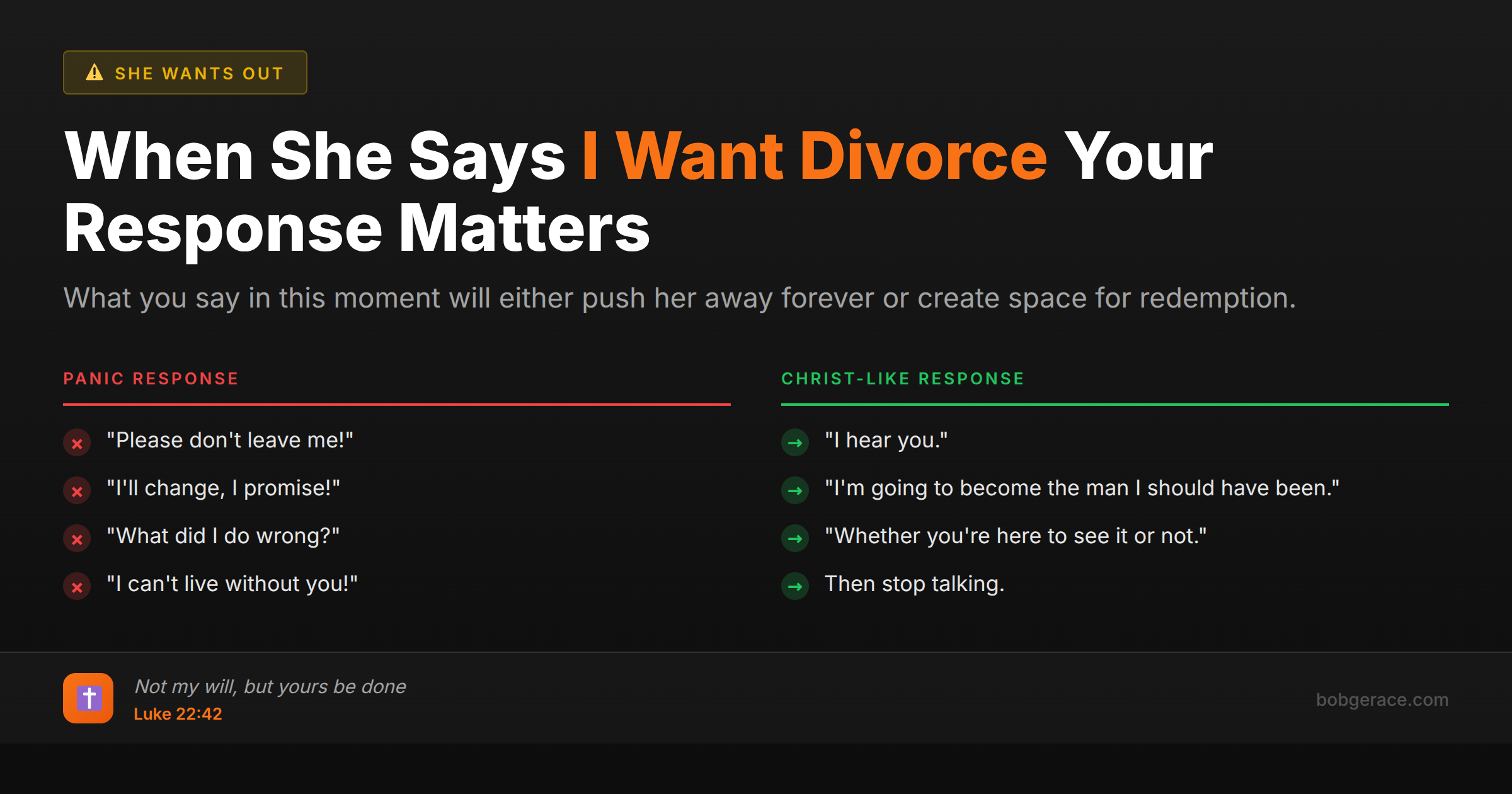
When your wife says she wants a divorce, your first instinct will be to panic, argue, or beg. Don't. Instead, take a breath and say something like: "I can see you're in pain, and I've contributed to that. I don't want our marriage to end, but I respect that this is where you are right now. Can we talk about what led us here?" This response does three critical things: it acknowledges her pain without dismissing it, takes responsibility without groveling, and creates space for dialogue instead of defense. Most men either explode with anger or collapse into desperation. Both responses push her further away. What she needs to see is a man who can handle hard truths and respond with strength and humility.
The Full Picture
When your wife asks for divorce, you're facing the most critical conversation of your marriage. Your response in this moment will either open a door to healing or slam it shut forever. Most men get this catastrophically wrong because they respond from fear rather than wisdom.
The three responses that destroy any chance of reconciliation: • Immediate rejection - "You don't mean that" or "You're being dramatic" • Panic and bargaining - "I'll change, just give me another chance" • Anger and blame - "After everything I've done for you" or "You're breaking up our family"
Each of these responses confirms what she already believes: that you don't truly see her, understand her pain, or take responsibility for your part in the breakdown.
What she's really saying when she asks for divorce isn't just "I want out." She's saying "I've been drowning in this marriage and you haven't noticed," or "I've lost all hope that things can change," or "I don't feel safe being vulnerable with you anymore."
The response that creates possibility acknowledges her reality without accepting defeat. It shows emotional maturity, takes ownership, and demonstrates that you can handle difficult conversations without falling apart or getting defensive. This doesn't mean you agree to divorce - it means you're finally ready to have the real conversation about what's been broken.
Remember: she didn't arrive at this decision overnight. She's been thinking about this for months, maybe years. Your job isn't to immediately change her mind - it's to show her a version of yourself she hasn't seen before.
What's Really Happening
From a therapeutic perspective, when a spouse asks for divorce, they've typically moved through what Gottman calls the 'cascade toward divorce' - criticism, contempt, defensiveness, and finally stonewalling. By the time they verbalize wanting out, they've often emotionally detached as a protective mechanism.
Neurologically, her brain has shifted into threat-detection mode regarding the relationship. The amygdala hijack that occurs during relationship distress means she's literally unable to access the same emotional centers that once felt love and connection. This isn't about logic anymore - it's about felt safety.
Research shows that the pursuing-distancing dynamic is at play here. The more you chase, plead, or argue, the more her nervous system interprets this as pressure, triggering further withdrawal. What interrupts this cycle is what we call 'differentiation' - your ability to stay connected to yourself while remaining emotionally available to her.
The most effective therapeutic intervention at this stage is what we call 'radical acceptance.' This doesn't mean passively accepting divorce, but rather accepting the reality of where she is emotionally right now. This paradoxically creates the psychological space she needs to potentially reconnect.
Studies on marriage recovery show that relationships can recover from even this point, but only when both partners feel heard and when the pursuing partner demonstrates genuine change rather than just promising it. Your initial response sets the tone for whether she'll even be willing to engage in that process.
What Scripture Says
Scripture provides profound wisdom for responding to crisis in marriage. Proverbs 15:1 reminds us that "A gentle answer turns away wrath, but a harsh word stirs up anger." When your wife asks for divorce, she's often coming from a place of deep hurt and frustration. A gentle, thoughtful response can defuse the immediate tension and create space for healing.
James 1:19 instructs us to "be quick to listen, slow to speak and slow to become angry." This is perhaps the most crucial verse for this moment. Your natural instinct will be to immediately defend yourself or counter-attack, but wisdom calls you to listen first. What is her heart really saying beneath the word 'divorce'?
Philippians 2:3-4 challenges us to "do nothing out of selfish ambition or vain conceit. Rather, in humility value others above yourselves, not looking to your own interests but each of you to the interests of the others." When facing divorce, it's tempting to focus solely on what you're losing or how this affects you. Christ calls you to consider her pain and what has led her to this desperate place.
1 Peter 3:7 specifically addresses husbands: "live with your wives in an understanding way, showing honor to the woman as the weaker vessel, since they are heirs with you of the grace of life." The word 'understanding' here means gaining knowledge through experience. Have you truly sought to understand her experience in your marriage?
Ephesians 4:26 says "In your anger do not sin." You will likely feel angry when she asks for divorce, but how you handle that anger will determine whether reconciliation is possible. Scripture doesn't forbid anger, but it demands that anger not lead us into sin - including the sin of a harsh response that wounds further.
God hates divorce (Malachi 2:16) not because He's legalistic, but because He knows the pain it causes His children. Yet He also calls husbands to love sacrificially (Ephesians 5:25). Sometimes that sacrificial love means absorbing the pain of her words without retaliating, creating space for healing rather than demanding immediate resolution.
What To Do Right Now
-
1
Take three deep breaths before responding - your immediate reaction will likely push her further away
-
2
Acknowledge her pain with words like 'I can see you're hurting' or 'I know this has been difficult for you'
-
3
Take responsibility without over-explaining: 'I know I've contributed to the problems in our marriage'
-
4
Ask permission to understand: 'Can you help me understand what's led you to this point?' rather than arguing or defending
-
5
Resist the urge to immediately propose solutions or promise changes - focus first on truly hearing her heart
-
6
End with your position clearly but gently: 'I don't want our marriage to end, but I respect where you are right now'
Related Questions
- What are the first words out of my mouth?
- Should I try to talk her out of it immediately?
- Do I show emotion or stay calm?
- What if I already reacted badly?
- She dropped the bomb — what do I do in the next 24 hours?
- How do I respond to divorce papers?
- I just found out — what do I do in the next hour?
- How do I not lose my mind right now?
- What does biblical forgiveness require of me?
- How do I pray when I can't form words?
Also find Bob on
Subscribe for weekly videos on Christian marriage.
Bring Your Situation to Bob
When divorce is on the table, generic advice won't cut it. A coach who knows your marriage, your wife's specific pain points, and where you actually are can help you respond in ways that create space instead of closing doors.
Talk to Bob →