What does the 'ambiguous loss' of marital limbo do to a person?
6 min read
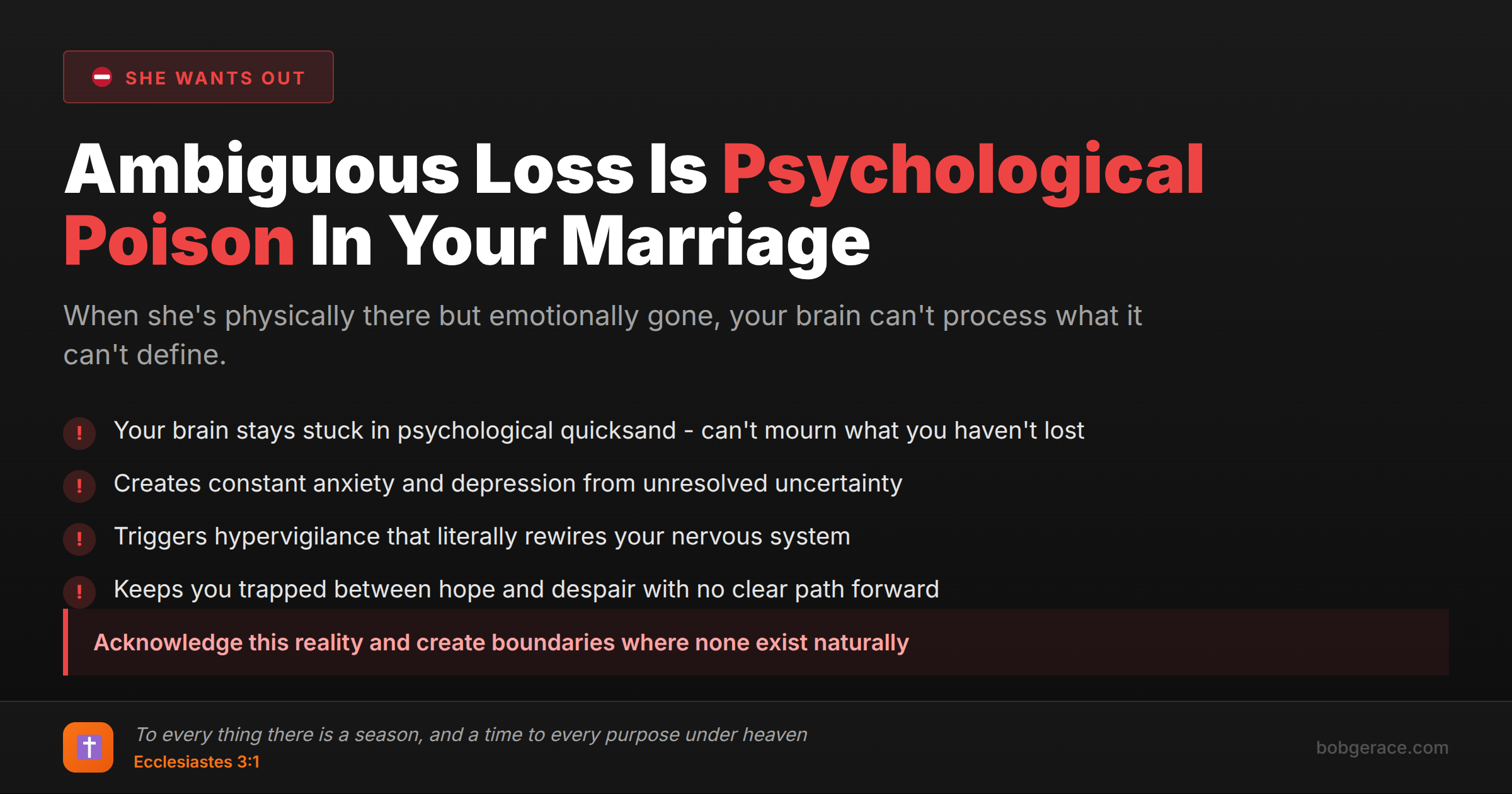
Ambiguous loss in marriage is psychological poison. It's the torment of being married but not really married - your wife is physically present but emotionally gone, and you're trapped in a hell of uncertainty. This isn't just difficult, it's traumatic. Your brain can't process what it can't define. With a clear loss like death or divorce, you grieve and eventually heal. But ambiguous loss keeps you stuck in psychological quicksand - you can't mourn what you haven't lost, and you can't hope for what seems gone. This creates anxiety, depression, and a constant state of hypervigilance that literally rewires your nervous system.
The Full Picture
Ambiguous loss is the most stressful type of loss because it defies resolution. In your marriage, you're experiencing two forms simultaneously: physical presence with psychological absence (your wife is there but emotionally unavailable) and psychological presence with physical absence (she may have moved out but you're still married).
This creates what researchers call "boundary ambiguity" - you don't know if you're single or married, hopeful or hopeless, fighting for your marriage or letting go. Your brain craves certainty to function properly, and this limbo state triggers constant stress responses.
The psychological effects compound daily: • Decision paralysis - You can't make major life choices because you don't know your status • Emotional exhaustion - Constantly managing hope and despair drains your reserves • Social isolation - Friends don't know how to help with something so undefined • Identity confusion - Are you a husband working on your marriage or a man whose marriage is over?
Common mistakes men make: Trying to force clarity through ultimatums (backfires), avoiding the pain through workaholism or substances (prolongs agony), or oscillating between extreme hope and despair (emotional whiplash).
The cruel irony is that your attempts to resolve the ambiguity often increase it. Pushing for answers pushes her away. Backing off feels like giving up. You're damned if you do, damned if you don't - which is exactly what makes ambiguous loss so devastating.
What's Really Happening
Pauline Boss's groundbreaking research on ambiguous loss reveals why marital limbo is so psychologically destructive. The human brain has evolved to process clear losses through predictable grief stages, but ambiguous loss hijacks this natural healing process.
Neurologically, uncertainty activates the same threat-detection systems as physical danger. Your amygdala stays hyperactive, flooding your system with stress hormones like cortisol and adrenaline. Over time, this creates chronic dysregulation - your nervous system gets stuck in fight-or-flight mode.
Attachment theory explains the deeper wound: When your primary attachment figure (your wife) becomes inconsistently available, it triggers primal abandonment fears. This isn't weakness; it's biology. Your attachment system was designed for consistency and predictability.
The trauma manifests in several ways: Cognitive symptoms include rumination, decision fatigue, and difficulty concentrating. Emotional symptoms range from anxiety and depression to emotional numbing and rage. Physical symptoms often include sleep disruption, appetite changes, and chronic tension.
Therapeutic intervention focuses on: 1. Tolerance building - Learning to hold uncertainty without it consuming you 2. Meaning reconstruction - Finding purpose despite the ambiguity 3. Boundary clarification - Defining what you can and cannot control 4. Somatic regulation - Calming your nervous system through body-based practices
Recovery isn't about resolving the ambiguity - that may be impossible. It's about developing the capacity to function and even thrive within uncertainty.
What Scripture Says
Scripture acknowledges that uncertainty and waiting are part of the human experience, but it provides a framework for enduring ambiguous seasons with faith and wisdom.
Ecclesiastes 3:1 reminds us: "To every thing there is a season, and a time to every purpose under heaven." This includes seasons of not knowing, of waiting, of being in between what was and what will be. God doesn't promise to eliminate uncertainty, but to be present in it.
Psalm 27:14 commands: "Wait on the Lord: be of good courage, and he shall strengthen thine heart: wait, I say, on the Lord." Waiting isn't passive resignation - it's active trust that requires courage and produces strength. Your marital limbo can become a season of spiritual formation if you let it.
Proverbs 3:5-6 provides the antidote to decision paralysis: "Trust in the Lord with all thine heart; and lean not unto thine own understanding. In all thy ways acknowledge him, and he shall direct thy paths." When your understanding fails to provide clarity, trust becomes your compass.
Romans 8:28 offers hope in the midst of painful uncertainty: "And we know that all things work together for good to them that love God, to them who are the called according to his purpose." Even this ambiguous loss can serve God's purposes in your life.
James 1:2-4 reframes suffering: "Count it all joy when ye fall into divers temptations; Knowing this, that the trying of your faith worketh patience. But let patience have her perfect work, that ye may be perfect and entire, wanting nothing." Your trial of ambiguous loss can produce spiritual maturity.
1 Peter 5:7 provides practical relief: "Casting all your care upon him; for he careth for you." The weight of uncertainty doesn't have to crush you when you transfer it to God's capable hands.
What To Do Right Now
-
1
Acknowledge the reality of ambiguous loss - stop minimizing the psychological impact this is having on you
-
2
Establish daily nervous system regulation practices - deep breathing, prayer, physical exercise, or meditation
-
3
Create artificial boundaries where natural ones don't exist - set specific times for marriage conversations
-
4
Focus your energy on what you can control - your responses, growth, and character development
-
5
Build a support network that understands ambiguous loss - counselor, support group, or trusted friends
-
6
Practice radical acceptance - surrendering the outcome while remaining faithful to your responsibilities
Related Questions
- How long do I wait before giving up?
- When is it actually over?
- How do I grieve a marriage that isn't dead yet?
- What is 'closure' and do I need it to move on?
- What's the difference between standing and stagnating?
- How do I know if I'm in denial or in faith?
- What is 'betrayal trauma' and do I have it?
- Why do I feel like I'm going to die?
- How do I live with uncertainty?
- What does healing timeline look like?
Also find Bob on
Subscribe for weekly videos on Christian marriage.
Your Marriage Isn't a Textbook Case
Ambiguous loss hits different in every relationship. A coach who knows your specific situation can help you stop spinning and start making decisions that actually fit where you are.
Talk to Bob →