What if she wants to move away with the kids?
6 min read
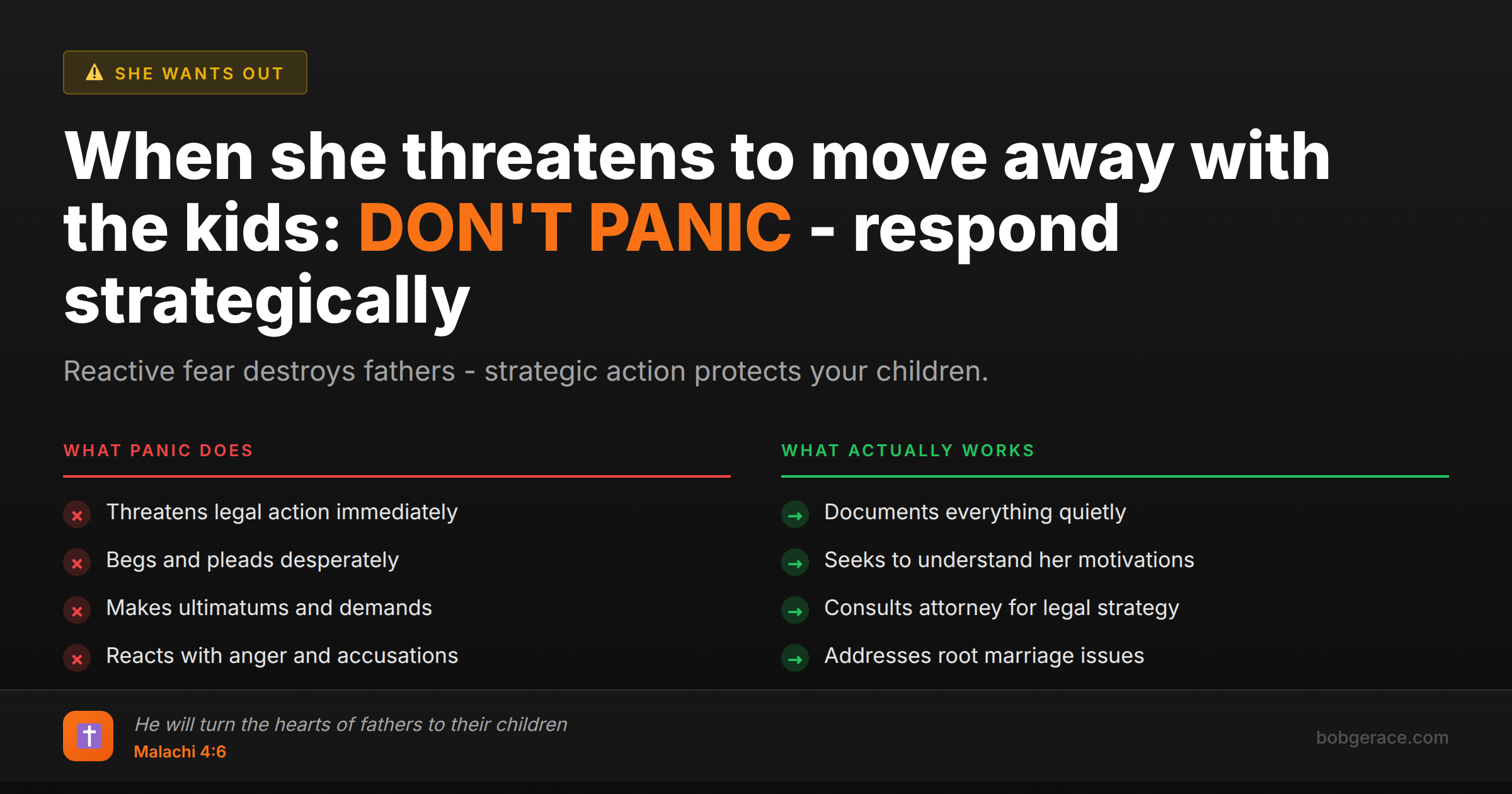
This is every father's worst nightmare - the threat of losing daily access to your children. Whether she's using this as leverage in arguments or she's seriously planning to relocate, you need to act strategically, not reactively. The panic you feel is real, but knee-jerk responses will backfire and potentially give her more ammunition. Here's the truth: legally, she cannot simply take your children and move without proper procedures. Most states require court approval for relocations that significantly impact the other parent's time. But don't rely on legal technicalities alone - your best defense is becoming the husband and father your family needs, while simultaneously protecting your parental rights through proper channels.
The Full Picture
When a wife threatens to move away with the children, it's rarely just about geography. This threat often represents her feelings of hopelessness about the marriage and her belief that distance is the only way to start fresh. Understanding this doesn't minimize your pain, but it helps you respond more effectively.
The legal reality varies by state, but generally includes: • Most jurisdictions require court approval for relocations beyond a certain distance • The relocating parent must prove the move serves the children's best interests • Courts consider factors like job opportunities, family support, and maintaining relationships with both parents • Emergency relocations are rare and require evidence of immediate danger
Common triggers for relocation threats: • Feeling trapped in an unhappy marriage • Wanting to be closer to family support systems • Career opportunities in another location • Believing a fresh start will solve underlying problems • Using the threat as leverage to force change in the marriage
Your biggest mistakes right now would be: • Threatening legal action without first trying to understand her motivations • Making this solely about your rights instead of the children's wellbeing • Reacting with anger instead of strategic thinking • Ignoring the underlying marriage issues that brought you to this point
Remember, even if she has legitimate reasons for wanting to move, the court's primary concern is the children's best interests - which almost always includes maintaining strong relationships with both parents.
What's Really Happening
From a psychological perspective, relocation threats during marital crisis often represent what we call 'geographic escape fantasy' - the belief that changing location will solve internal and relational problems. Research consistently shows that unresolved relationship patterns follow us wherever we go.
For wives in distressed marriages, the desire to relocate often stems from feeling emotionally unsafe or unsupported in the current environment. Studies indicate that women are more likely to consider relocation when they perceive their social support networks as inadequate or when they feel isolated within the marriage. The threat itself can serve multiple psychological functions: testing the husband's commitment, seeking control in a situation where she feels powerless, or creating urgency around marital problems that have been ignored.
The impact on children is significant. Research from the American Academy of Matrimonial Lawyers shows that children in high-conflict custody situations involving relocation show increased rates of anxiety, depression, and behavioral problems. However, children also suffer when trapped in homes with ongoing marital conflict.
Attachment theory helps us understand that children need secure, consistent relationships with both parents. When one parent threatens to relocate, it triggers the child's fundamental fear of abandonment - either losing the relocating parent if they stay, or losing the remaining parent if they go.
The most psychologically healthy approach involves addressing the underlying marital distress while ensuring both parents remain actively involved in the children's lives. This requires moving beyond positional bargaining ('you can't take my kids') to interest-based problem solving ('how do we create the best environment for our children while addressing everyone's legitimate needs').
What Scripture Says
Scripture provides clear guidance on both parental responsibility and conflict resolution that applies directly to this situation.
Malachi 4:6 tells us God's heart: *"And he will turn the hearts of fathers to their children and the hearts of children to their fathers, lest I come and strike the land with a decree of utter destruction."* This passage emphasizes that God values the father-child relationship as essential for family and societal wellbeing.
Ephesians 6:4 instructs: *"Fathers, do not provoke your children to anger, but bring them up in the discipline and instruction of the Lord."* You cannot fulfill this biblical mandate if you're geographically separated from your children. Your role as father is not optional - it's a divine calling that requires your presence and involvement.
Matthew 18:15-17 provides the framework for addressing conflict: *"If your brother sins against you, go and tell him his fault, between you and him alone. If he listens to you, you have gained your brother."* Applied to marriage, this means direct, loving communication before involving outside parties - including attorneys.
1 Corinthians 7:10-11 addresses marital separation: *"To the married I give this charge (not I, but the Lord): the wife should not separate from her husband (but if she does, she should remain unmarried or else be reconciled to her husband), and the husband should not divorce his wife."* Even in separation, the goal remains reconciliation, not permanent division.
Philippians 2:3-4 calls us to: *"Do nothing from selfish ambition or conceit, but in humility count others more significant than yourselves. Let each of you look not only to his own interests, but also to the interests of others."* This means considering what's truly best for your children, not just fighting for your parental rights.
What To Do Right Now
-
1
Document everything - keep records of all conversations about relocation, her stated reasons, and any threats made
-
2
Consult with a family law attorney immediately to understand your legal rights and your state's relocation requirements
-
3
Schedule a calm, private conversation with your wife to understand her underlying motivations without becoming defensive
-
4
Propose alternative solutions that address her concerns while keeping the family together geographically
-
5
Begin intensive marriage counseling with a qualified therapist who understands both individual and systemic issues
-
6
Increase your involvement in your children's daily activities to demonstrate your commitment to active parenting
Related Questions
- How do I tell the kids?
- What are my rights regarding the children?
- How do I co-parent during this?
- She's turning the kids against me
- How do I be a good dad through this?
- What do I say when kids ask what's happening?
- What are signs my kids are struggling?
- How do I stay connected when access is limited?
Also find Bob on
Subscribe for weekly videos on Christian marriage.
Your Kids Need You Strategic Today
This isn't abstract marriage work—it's your custody reality. Bob's coached fathers through this exact threat. He'll calibrate to your specific situation: what she's actually planning, what your state allows, how you respond without escalating.
Talk to Bob →