What if they don't repent — do I still forgive?
6 min read
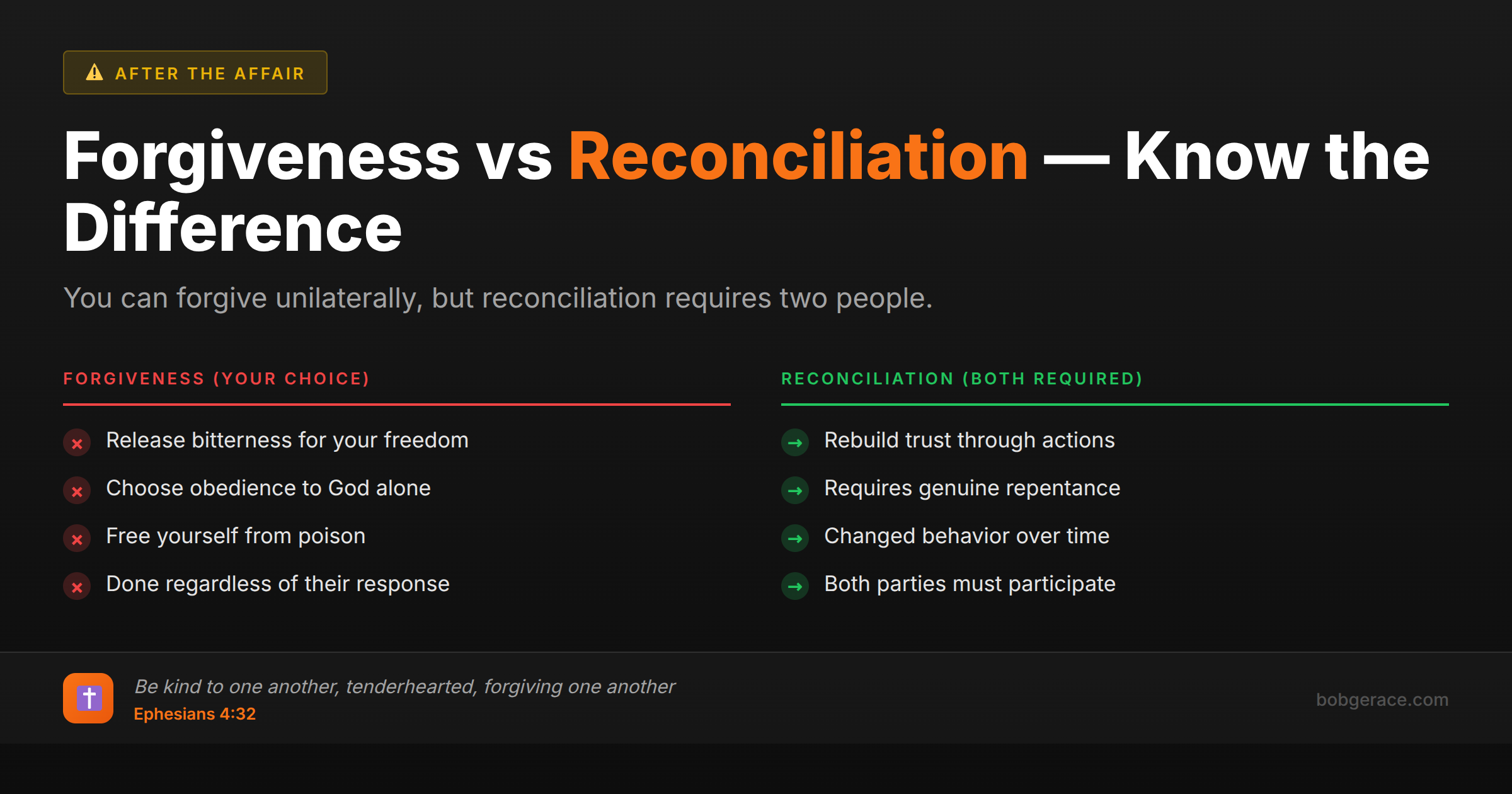
Yes, you still forgive — but forgiveness and reconciliation are two different things. Biblical forgiveness is a choice you make for your own freedom and obedience to God, regardless of whether your spouse repents. It doesn't mean pretending the hurt didn't happen or immediately returning to business as usual. Forgiveness releases you from the poison of bitterness and allows God to work in both your hearts. However, rebuilding trust and full reconciliation requires repentance, acknowledgment of wrongdoing, and changed behavior. You can forgive unilaterally, but reconciliation is a two-person process that requires both parties to participate.
The Full Picture
This is one of the most challenging questions in marriage, and honestly, one where a lot of Christians get confused. We've been told to forgive, but what does that actually look like when your spouse hasn't even acknowledged they did anything wrong?
Here's the truth: forgiveness is not the same as reconciliation. Forgiveness is what you do in your heart before God. It's releasing the debt, choosing not to hold onto bitterness, and trusting God with the outcome. Reconciliation is what happens between two people when there's repentance, acknowledgment, and a commitment to change.
Think of it this way — God forgives us while we're still sinners, but relationship with Him requires repentance. Jesus died for the whole world, but not everyone experiences salvation because not everyone repents and believes.
When your spouse hasn't repented, you're called to forgive for your own spiritual health and freedom. Unforgiveness is like drinking poison and expecting the other person to get sick. It destroys you from the inside out. But that doesn't mean you pretend everything is fine or immediately return to full vulnerability.
Forgiveness without repentance looks like: - Releasing bitterness and the desire for revenge - Praying for your spouse rather than cursing them - Not constantly bringing up past offenses - Choosing to see them through God's eyes - Trusting God to work in their heart
But it doesn't mean: - Pretending the hurt didn't happen - Immediately returning to full intimacy - Dropping all boundaries - Enabling continued harmful behavior - Bypassing the need for accountability
What's Really Happening
From a therapeutic standpoint, the distinction between forgiveness and reconciliation is crucial for emotional health. When we conflate these two concepts, we often create additional trauma and prevent genuine healing.
Forgiveness is an internal process that serves the forgiver's psychological well-being. Research consistently shows that people who practice forgiveness experience lower rates of depression, anxiety, and stress-related //blog.bobgerace.com/physical-fitness-christian-marriage-body-temple/:physical symptoms. However, this doesn't require the participation of the offending party.
Reconciliation, on the other hand, is a relational process that requires acknowledgment of harm, genuine remorse, and behavioral change from the offender. Attempting reconciliation without these elements often leads to repeated trauma and can actually reinforce harmful patterns.
Many people struggle with what I call 'forced forgiveness' — pressuring themselves to feel differently before they've processed the hurt. This often backfires and creates shame about having normal human emotions. True forgiveness is a process, not a one-time event.
I often tell clients that forgiveness is like removing a fishhook. You don't just yank it out — you work it out carefully to avoid causing more damage. This process takes time and often requires support. The goal isn't to minimize the hurt or excuse the behavior, but to prevent the offense from continuing to wound you.
It's also important to understand that maintaining boundaries while forgiving is not only healthy — it's wise. Boundaries protect the relationship by creating space for potential healing while preventing further harm.
What Scripture Says
Scripture gives us clear guidance on both forgiveness and the process of reconciliation, showing they're related but distinct concepts.
On Unconditional Forgiveness: *"Be kind to one another, tenderhearted, forgiving one another, as God in Christ forgave you."* - Ephesians 4:32
*"Then Peter came up and said to him, 'Lord, how often will my brother sin against me, and I forgive him? As many as seven times?' Jesus said to him, 'I do not say to you seven times, but seventy-seven times.'"* - Matthew 18:21-22
These passages make it clear that forgiveness is not conditional on the other person's response. We forgive because Christ forgave us, not because the other person deserves it.
On Reconciliation and Repentance: *"If your brother sins against you, go and tell him his fault, between you and him alone. If he listens to you, you have gained your brother."* - Matthew 18:15
*"Pay attention to yourselves! If your brother sins, rebuke him, and if he repents, forgive him."* - Luke 17:3
Notice that Jesus gives a process for addressing sin that includes confrontation and the expectation of repentance for full reconciliation.
The Model of God's Forgiveness: *"All this is from God, who reconciled us to himself through Christ and gave us the ministry of reconciliation."* - 2 Corinthians 5:18
*"If we confess our sins, he is faithful and just to forgive us our sins and to cleanse us from all unrighteousness."* - 1 John 1:9
God demonstrates both unconditional love (Christ died while we were still sinners) and the requirement of repentance for full reconciliation (confession is required for cleansing).
What To Do Right Now
-
1
Choose to forgive in your heart before God — This is between you and God, regardless of your spouse's response
-
2
Process your emotions honestly — Don't spiritualize away legitimate hurt; bring it to God and trusted counselors
-
3
Maintain appropriate boundaries — Protect yourself and the relationship while keeping the door open for reconciliation
-
4
Pray for your spouse consistently — Ask God to work in their heart and give you His perspective
-
5
Address the issue directly but lovingly — Follow Matthew 18 principles in confronting sin
-
6
Seek wise counsel and support — Don't walk this journey alone; get help from mature believers and professionals
Related Questions
Need Help Navigating Forgiveness?
Working through forgiveness without repentance is one of the hardest things you'll face. You don't have to figure this out alone.
Get Support →