What role did my childhood play in my anger patterns?
6 min read
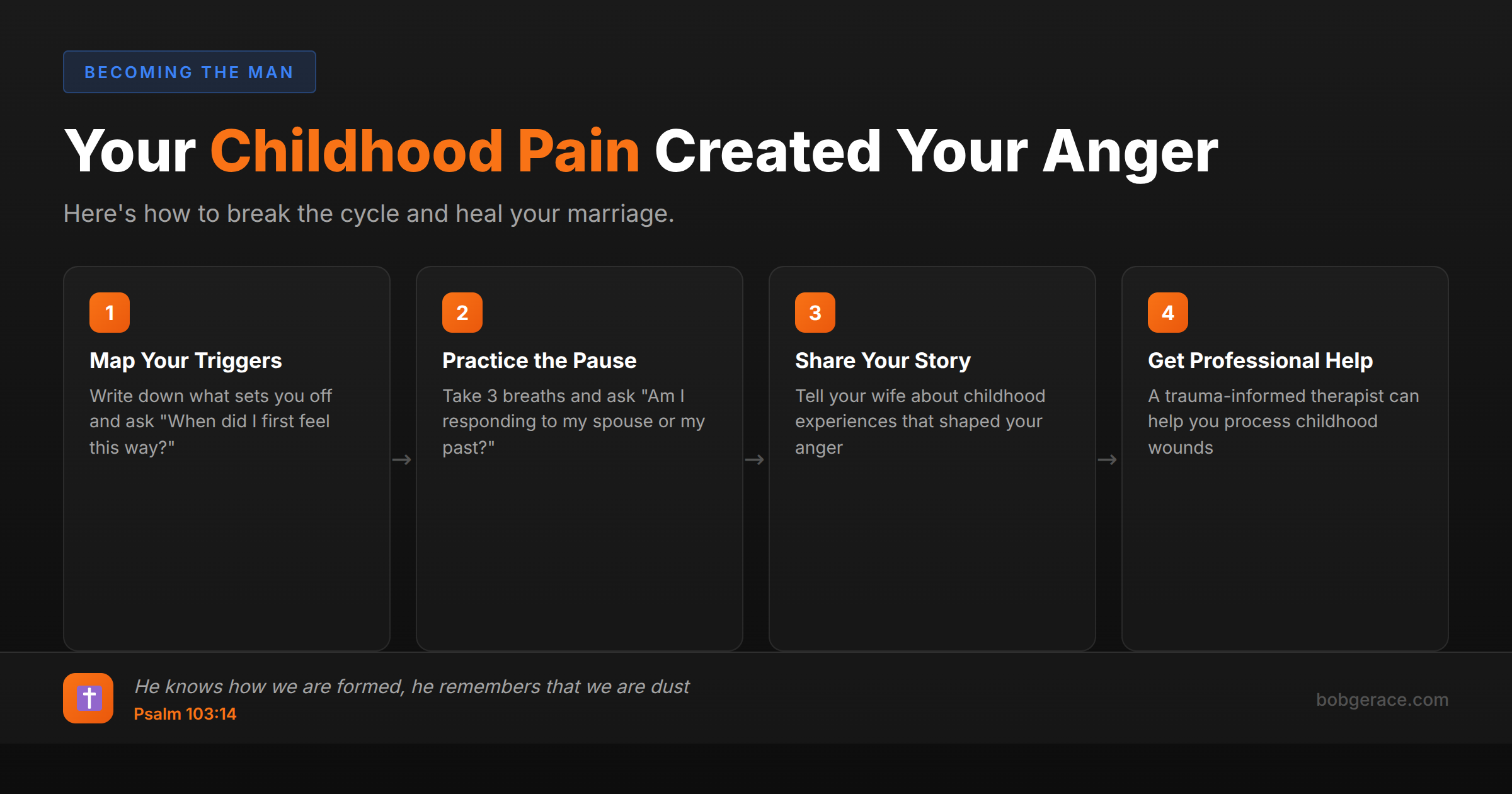
Your childhood experiences significantly shaped your current anger patterns through learned responses, attachment styles, and neural pathways formed during critical developmental years. Children who witnessed explosive anger, experienced trauma, or lived in unpredictable environments often develop hypervigilant stress responses that trigger intense anger in adulthood. These patterns aren't your fault, but they are your responsibility to address. The good news is that understanding these connections is the first step toward freedom. Your brain's neuroplasticity means you can literally rewire these responses through intentional practice, prayer, and often professional help. While you can't change your past, you can absolutely change how it affects your present relationships.
The Full Picture
Your childhood didn't just influence your anger—it programmed your nervous system's default responses to stress, conflict, and perceived threats. Between birth and age seven, your brain was like wet cement, absorbing patterns from your caregivers and environment that would harden into automatic responses.
Common Childhood Contributors to Adult Anger:
- Modeling: If you saw explosive anger as normal problem-solving, your brain filed that as "how adults handle conflict" - Trauma responses: Abuse, neglect, or chaos created hypervigilance that now triggers fight-or-flight over minor issues - Emotional neglect: Never learning healthy emotional regulation leaves you overwhelmed by normal feelings - Inconsistent caregiving: Unpredictable responses taught you that relationships are unsafe, triggering defensive anger - Perfectionism pressure: Impossible standards created shame that now erupts as rage when you feel criticized
Here's what's crucial: These patterns served a purpose then. Your anger may have been the only way to feel powerful in powerless situations, or to protect yourself from further hurt. That angry child inside you was doing their best to survive.
But what protected you then is now destroying your marriage. The same fight-or-flight response that helped you navigate childhood chaos now explodes over dishes in the sink or different parenting opinions. Your spouse isn't your critical parent or unpredictable caregiver, but your nervous system doesn't know that.
Recognizing these patterns isn't about excusing your behavior or blaming your parents. It's about understanding the "why" so you can change the "what happens next." You're not doomed to repeat these cycles. With God's help and intentional work, you can break generational patterns and model something different for your own children.
What's Really Happening
From a clinical perspective, childhood experiences literally shape our brain's architecture through a process called neuroplasticity. The amygdala—our brain's alarm system—becomes hyperactive in adults who experienced chronic stress or trauma as children. This creates what we call "emotional hijacking," where your brain perceives normal marital conflict as life-threatening danger.
Attachment theory helps us understand these patterns. If your caregivers were inconsistently available, dismissive, or frightening, you likely developed an "insecure attachment style." This manifests in marriage as either explosive anger when feeling abandoned (anxious attachment) or cold withdrawal when feeling overwhelmed (avoidant attachment).
The fascinating part is that your brain can't distinguish between past and present threats. When your spouse uses a certain tone or gives you "that look," your unconscious mind may be responding to your critical father or overwhelmed mother. This isn't weakness—it's normal trauma response.
However, awareness creates the possibility for change. Through techniques like EMDR, cognitive behavioral therapy, and mindfulness practices, we can help your brain develop new neural pathways. The goal isn't to erase your history but to reduce its emotional charge and give you choice in how you respond.
Healing happens in relationship. Often, the very marriage that triggers your old wounds becomes the place where you experience new patterns of safety, consistency, and unconditional love. This is why doing this work together, with professional support, can be transformational for both partners.
What Scripture Says
Scripture acknowledges that our past profoundly impacts our present, while also declaring God's power to transform us completely. The Bible doesn't minimize childhood pain—it offers hope for complete restoration.
God sees and cares about your childhood pain: *"As a father has compassion on his children, so the Lord has compassion on those who fear him; for he knows how we are formed, he remembers that we are dust."* (Psalm 103:13-14)
Your past doesn't define your future: *"Therefore, if anyone is in Christ, the new creation has come: The old has gone, the new is here!"* (2 Corinthians 5:17)
God can redeem what was broken: *"And we know that in all things God works for the good of those who love him, who have been called according to his purpose."* (Romans 8:28)
Transformation requires both God's power and your participation: *"Continue to work out your salvation with fear and trembling, for it is God who works in you to will and to act in order to fulfill his good purpose."* (Philippians 2:12-13)
Breaking generational patterns: *"The Lord is slow to anger, abounding in love and forgiving sin and rebellion. Yet he does not leave the guilty unpunished; he punishes the children for the sin of the parents to the third and fourth generation."* (Numbers 14:18)
God's discipline brings healing: *"No discipline seems pleasant at the time, but painful. Later on, however, it produces a harvest of righteousness and peace for those who have been trained by it."* (Hebrews 12:11)
Your childhood experiences matter to God, and He wants to use even the painful parts for His glory and your good. This doesn't minimize the real damage done, but it offers supernatural hope for change.
What To Do Right Now
-
1
Map your triggers: Write down what specifically sets off your anger and ask yourself, "When did I first feel this way?"
-
2
Practice the pause: When triggered, take three deep breaths and ask, "Am I responding to my spouse or to my past?"
-
3
Share your story: Tell your spouse about your childhood experiences that shaped your anger patterns—vulnerability breeds connection
-
4
Consider professional help: A trauma-informed therapist can help you process childhood wounds that fuel current anger
-
5
Develop new responses: Practice responding to triggers with curiosity instead of reactivity—"I wonder why this bothers me so much"
-
6
Pray for healing: Ask God to heal childhood wounds and break generational patterns of anger in your family line
Related Questions
- What's underneath my anger?
- What is 'secondary emotion' and is anger covering something?
- What attachment style did I develop in childhood?
- What is 'intergenerational transmission'?
- What patterns did I inherit vs. choose?
- What did I learn about emotions from my father?
- What is 'family of origin' work?
- What does 'sins of the fathers' mean?
- How do generational patterns work spiritually?
- What attachment injuries did I experience?
Also find Bob on
Subscribe for weekly videos on Christian marriage.
Your Patterns Have a Story
A coach who knows your history can help you untangle what's yours to carry and what you can finally put down. You don't have to decode this alone.
Talk to Bob →