She wants separation — should I agree?
5 min read
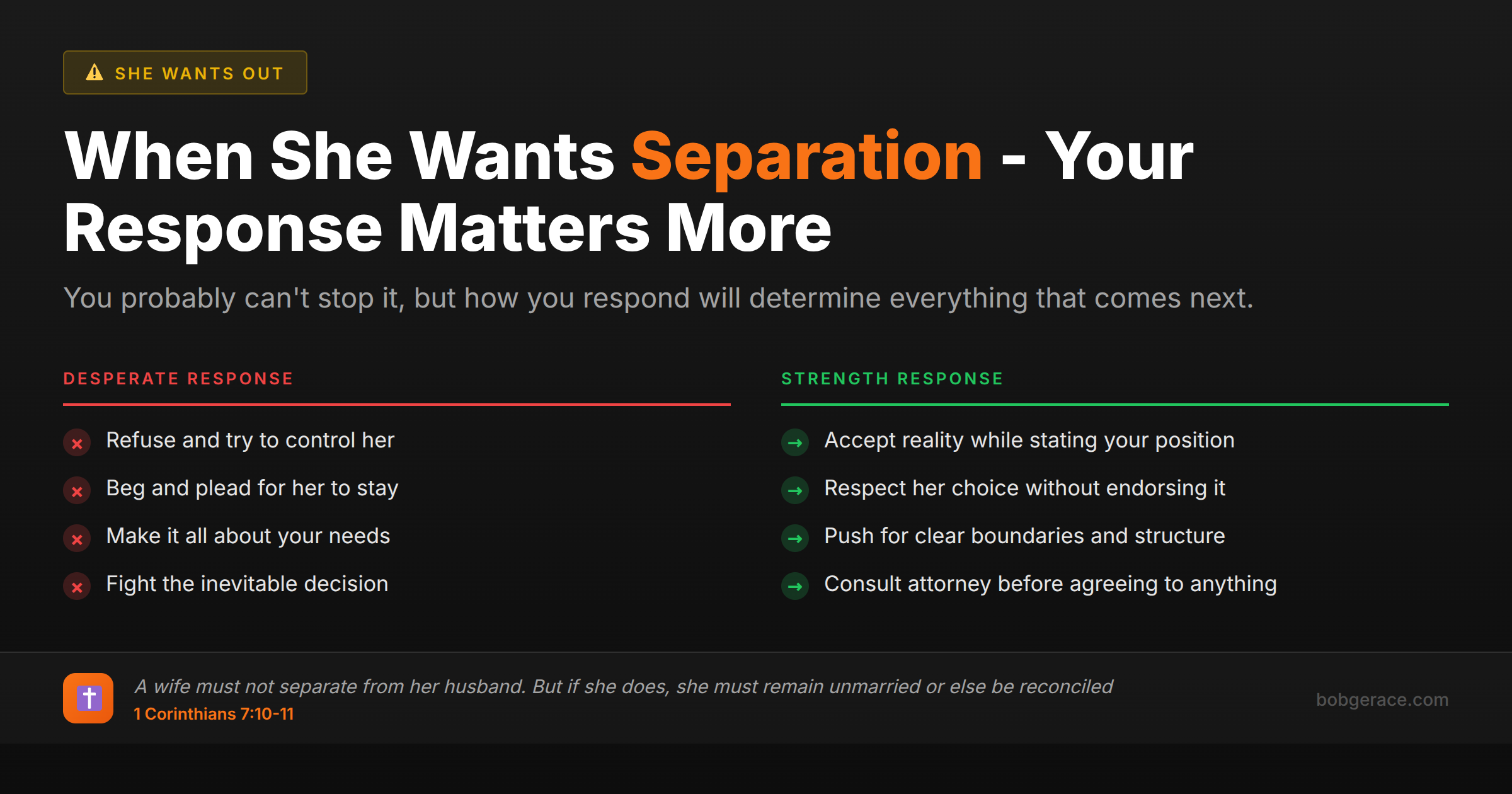
Don't rush into agreement just to avoid conflict or show you're "reasonable." This decision will shape everything that follows—your access to your home, children, finances, and your ability to work on the marriage. While you can't force her to stay, you have legitimate concerns and rights that deserve consideration. The key isn't whether you should agree, but understanding what you're agreeing TO. What are the specific terms? How long? What about counseling, the house, the kids? A knee-jerk "yes" or "no" often backfires. Take time to think strategically about what serves the marriage's best interests while protecting yourself and your children.
The Full Picture
When your wife asks for separation, you're facing one of the most consequential decisions of your marriage. Your response will set the trajectory for months or even years ahead.
The agreement isn't just about her leaving—it's about the framework for everything that follows. Who stays in the house? How often do you see the kids? Who pays what bills? How long does this last? What happens to counseling or working on issues? These details matter enormously.
Common mistakes men make: • Agreeing immediately to show they're "supportive" or avoid being controlling • Refusing outright without understanding her perspective or exploring alternatives • Focusing only on the emotional pain instead of practical implications • Assuming separation always leads to divorce (it doesn't have to) • Not consulting professionals before major decisions
Consider the context behind her request. Is this her way of getting space to think, or has she already mentally checked out? Is she hoping separation will motivate change, or is she testing the waters of single life? Has she mentioned specific goals or timeline?
Strategic separation versus reactive separation makes all the difference. A structured separation with clear boundaries, timeframes, and goals for reconciliation can sometimes help marriages. A vague "I need space" arrangement often becomes a slow slide toward divorce.
Your marriage may be salvageable, but only if both people are committed to doing the work. If she's using separation as an exit strategy, your agreement won't change that outcome—but it might affect how messy the process becomes.
What's Really Happening
Separation requests often represent what we call "protest behavior"—a last-ditch attempt to create change in the relationship dynamic. Research shows that women typically consider leaving for years before verbalizing it, meaning this moment represents significant accumulated distress.
From a therapeutic standpoint, your response here is crucial for several reasons. Attachment theory tells us that how couples handle separation and reunion attempts shapes their long-term relational patterns. An immediate "yes" might feel supportive but can inadvertently communicate that you're willing to abandon the relationship at the first sign of trouble. An immediate "no" often triggers her independence and can accelerate her exit process.
The most therapeutic approach involves curiosity before commitment. What outcomes is she hoping separation will achieve? What would need to change for her to feel hopeful about the marriage again? This isn't about changing her mind—it's about understanding the underlying relational dynamics.
Studies on marital separation show mixed outcomes. Approximately 13% of separated couples reconcile within the first year, with higher success rates when both partners engage in individual therapy and maintain some structured contact. However, separations initiated unilaterally by women have lower reconciliation rates than those initiated mutually.
The neurobiological reality is that separation activates both partners' attachment systems. Your brain will interpret this as a threat, potentially triggering fight-or-flight responses that can lead to poor decision-making. Taking time to process before responding isn't just strategic—it's allowing your prefrontal cortex to engage rather than operating from your amygdala.
What Scripture Says
Scripture calls husbands to love their wives sacrificially, but this doesn't mean agreeing to everything they request. Biblical love often requires difficult conversations and protective boundaries.
1 Corinthians 7:10-11 addresses separation directly: "To the married I give this command (not I, but the Lord): A wife must not separate from her husband. But if she does, she must remain unmarried or else be reconciled to her husband." This suggests separation, while not ideal, doesn't automatically end the covenant.
Matthew 19:3-6 reminds us that "what God has joined together, let no one separate." This doesn't mean you can prevent her from leaving, but it does mean you're called to fight for the marriage when possible and appropriate.
Ephesians 5:25 calls husbands to "love your wives, just as Christ loved the church and gave himself up for her." Sometimes sacrificial love means agreeing to space she needs; other times it means advocating for the marriage even when it's uncomfortable.
Proverbs 27:5 teaches that "better is open rebuke than hidden love." If separation is enabling destructive patterns or avoiding necessary growth, loving confrontation might be more biblical than passive agreement.
1 Corinthians 13:7 says love "always protects, always trusts, always hopes, always perseveres." This includes protecting your marriage from unnecessary damage, hoping for reconciliation, and persevering through difficulty—but it also means trusting God with outcomes you can't control.
The biblical approach balances fighting for your marriage with releasing control over your wife's choices, seeking wisdom from counselors and mature believers, and trusting God's sovereignty over the outcome.
What To Do Right Now
-
1
Ask for 48-72 hours to think before giving your answer—this isn't stalling, it's wisdom
-
2
Write down specific questions about logistics: timeline, living arrangements, children, finances, and counseling
-
3
Schedule individual sessions with a therapist or coach to process your options clearly
-
4
Consult with an attorney to understand your rights and potential implications (this is protective, not aggressive)
-
5
Pray and seek counsel from mature, married believers who know both of you
-
6
Respond with your decision and specific terms you need if you agree, or alternatives you'd prefer if you don't
Related Questions
- Should I move out if she asks?
- Is trial separation ever a good idea?
- What are the rules of separation?
- Can we separate and still work on things?
- What is 'structured separation' and does it work?
- How does moving out affect my legal position?
- What boundaries should I set?
- What's the difference between boundary and ultimatum?
- How do I give an ultimatum without losing her?
- What does biblical forgiveness require of me?
Also find Bob on
Subscribe for weekly videos on Christian marriage.
This Decision Needs a Coach
Your specific situation—kids, finances, her timeline, what she's actually asking for—changes the answer. Before you respond, talk to someone who knows your marriage.
Talk to Bob →