If I give space, won't she think I don't care?
6 min read
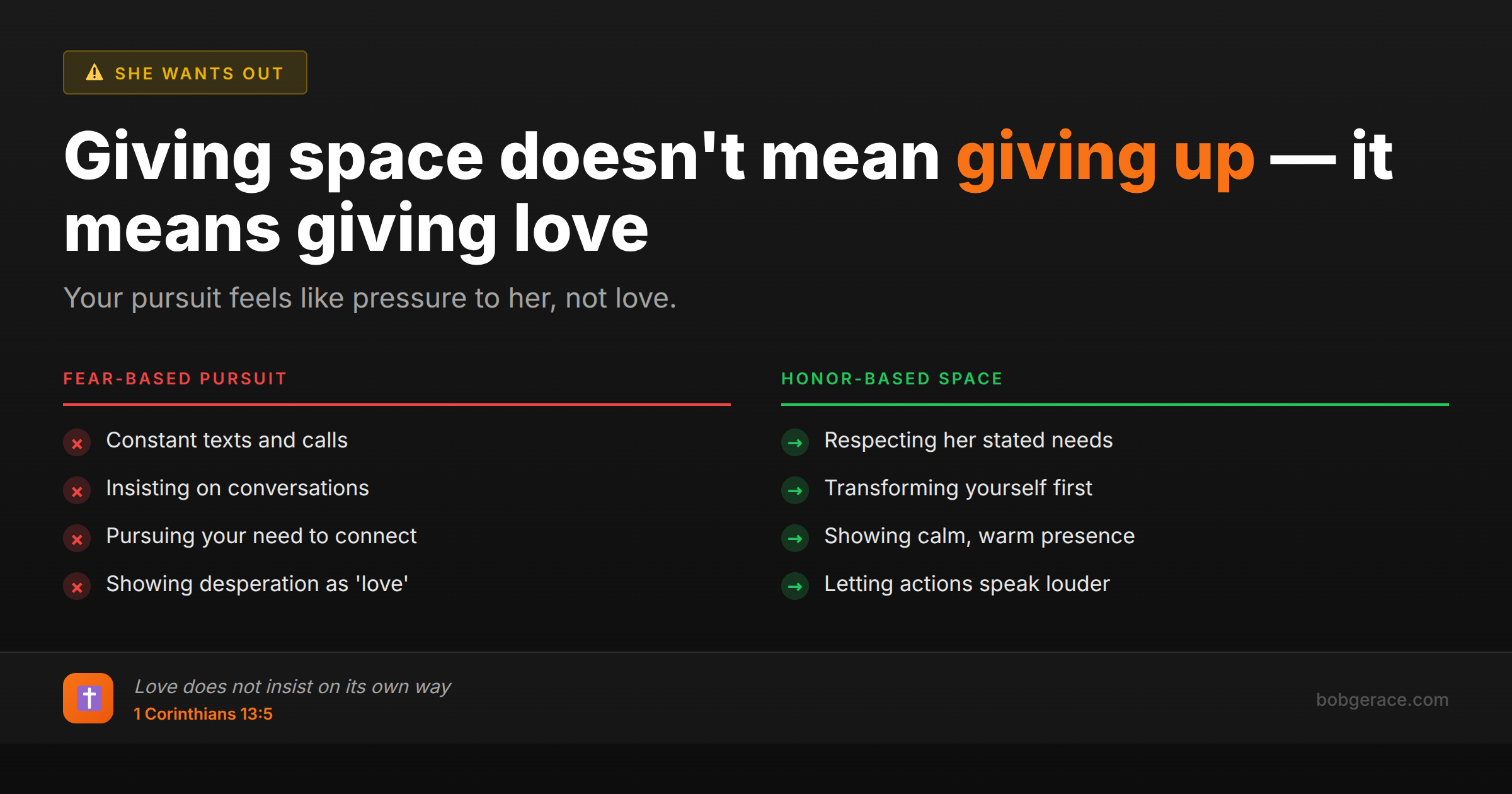
Here's the counterintuitive truth: giving space when she asks for it is one of the most caring things you can do. Your fear that space equals abandonment is exactly the mindset that got you here in the first place. When you chase, crowd, and smother her with attention she doesn't want, you're not showing love—you're showing desperation and disrespect for her clearly stated needs. Real love honors what the other person needs, even when it's uncomfortable for you. When you give her space gracefully, you're demonstrating emotional maturity, self-control, and genuine care for her wellbeing. She won't think you don't care—she'll finally have room to breathe and potentially remember why she fell in love with you in the first place.
The Full Picture
Your instinct to chase when she pulls away is completely normal but completely wrong. Most men operate from a scarcity mindset that says "if I'm not actively pursuing her, I'll lose her." But here's what's actually happening: she's already feeling suffocated, overwhelmed, or emotionally exhausted. Your pursuit feels like pressure, not love.
The space paradox works like this: • When you crowd her, she feels trapped and pulls away harder • When you give space respectfully, she has room to miss you • When you honor her request, you show emotional intelligence • When you demonstrate self-control, you become more attractive
Most men make these critical mistakes when giving space:
• Giving space with strings attached - "Fine, I'll give you space, but you better appreciate it" • Dramatic exits - Storming out or making it about your hurt feelings • Passive-aggressive compliance - Going silent but radiating resentment • Testing the boundaries - "Checking in" constantly to see if space-time is over
Real space means: - No guilt trips about her request - No constant texting "just to see how you're doing" - No showing up unannounced to "surprise" her - No making her feel bad for needing what she needs
When you give space correctly, you're communicating: "I love you enough to put your needs before my discomfort. I'm secure enough to trust our relationship. I respect you as a person, not just as my wife."
What's Really Happening
From a therapeutic standpoint, the request for space is often a last-ditch attempt to preserve the relationship, not end it. Research in attachment theory shows that when someone feels emotionally overwhelmed or engulfed, they activate what we call "deactivating strategies"—they create distance to regulate their nervous system.
The neuroscience is clear: when someone feels pressured or pursued against their will, their brain interprets this as a threat. The amygdala fires, stress hormones flood the system, and they enter fight-flight-or-freeze mode. Your wife isn't rejecting you personally—she's trying to get out of threat-response mode.
Studies on relationship satisfaction consistently show that couples who respect each other's autonomy report higher marital satisfaction. The Gottman Institute's research demonstrates that successful couples maintain what they call "positive sentiment override"—they give each other the benefit of the doubt and honor reasonable requests.
What happens psychologically when you give space correctly: - Her nervous system calms down - She experiences you as safe rather than threatening - She has cognitive space to process her feelings - The pressure valve releases, reducing her urge to flee
Conversely, when you violate her space boundaries, you're essentially telling her nervous system that you can't be trusted to respect her needs. This creates a trauma response that makes reconciliation exponentially harder. The clinical term is "relational trauma"—when the person who should feel safest becomes a source of threat through boundary violations.
What Scripture Says
Scripture is clear about honoring others above ourselves and treating our wives with understanding and respect. Philippians 2:3-4 says, "Do nothing out of selfish ambition or vain conceit. Rather, in humility value others above yourselves, not looking to your own interests but each of you to the interests of the others." When she asks for space, honoring that request is biblical love in action.
1 Peter 3:7 instructs husbands to "be considerate as you live with your wives, and treat them with respect as the weaker partner and as heirs with you of the gracious gift of life, so that nothing will hinder your prayers." Being considerate means paying attention to what she actually needs, not what you think she should need.
1 Corinthians 13:5 tells us that love "does not insist on its own way" (ESV). When you push for connection she doesn't want, you're insisting on your own way rather than demonstrating Christ-like love. Real love puts her wellbeing above your comfort.
Ecclesiastes 3:1 reminds us "there is a time for everything, and a season for every activity under the heavens." Sometimes the season calls for closeness, sometimes for space. Wisdom recognizes which season you're in.
Galatians 6:2 says "carry each other's burdens," but Galatians 6:5 says "each one should carry their own load." There's a balance between supporting each other and respecting individual responsibility. Giving space honors both principles.
The biblical model of love is self-sacrificial, not self-serving. When you give space gracefully, you're following Christ's example of putting others' needs above your own comfort.
What To Do Right Now
-
1
Tell her directly: 'I respect your need for space and I won't pressure you while you process things'
-
2
Stop all unsolicited contact—no texts, calls, visits, or 'check-ins' unless she initiates
-
3
Focus on your own growth by reading, exercising, connecting with male friends, and addressing your issues
-
4
Write down your anxious thoughts instead of acting on them or dumping them on her
-
5
Practice emotional regulation through prayer, meditation, or counseling when the urge to chase kicks in
-
6
Set a specific time frame in your mind (30-60 days) to honor her space without negotiating or asking for updates
Related Questions
- Should I give her space or fight for her?
- How much space is too much?
- What does 'space' actually mean to her?
- How do I fight without pushing her away?
- What's the difference between pursuing and chasing?
- When does giving space become abandonment?
- What is anxious attachment and am I doing it right now?
- Why does my pursuing make her pull away more?
- How do I pursue without pressuring?
- What does 'detach with love' actually mean?
Also find Bob on
Subscribe for weekly videos on Christian marriage.
Your Marriage Isn't Generic. Neither Is the Fix.
A coach who knows your specific situation can help you give space without disappearing—and stay grounded when your fear tells you to chase.
Talk to Bob →