Should I give her space or fight for her?
6 min read
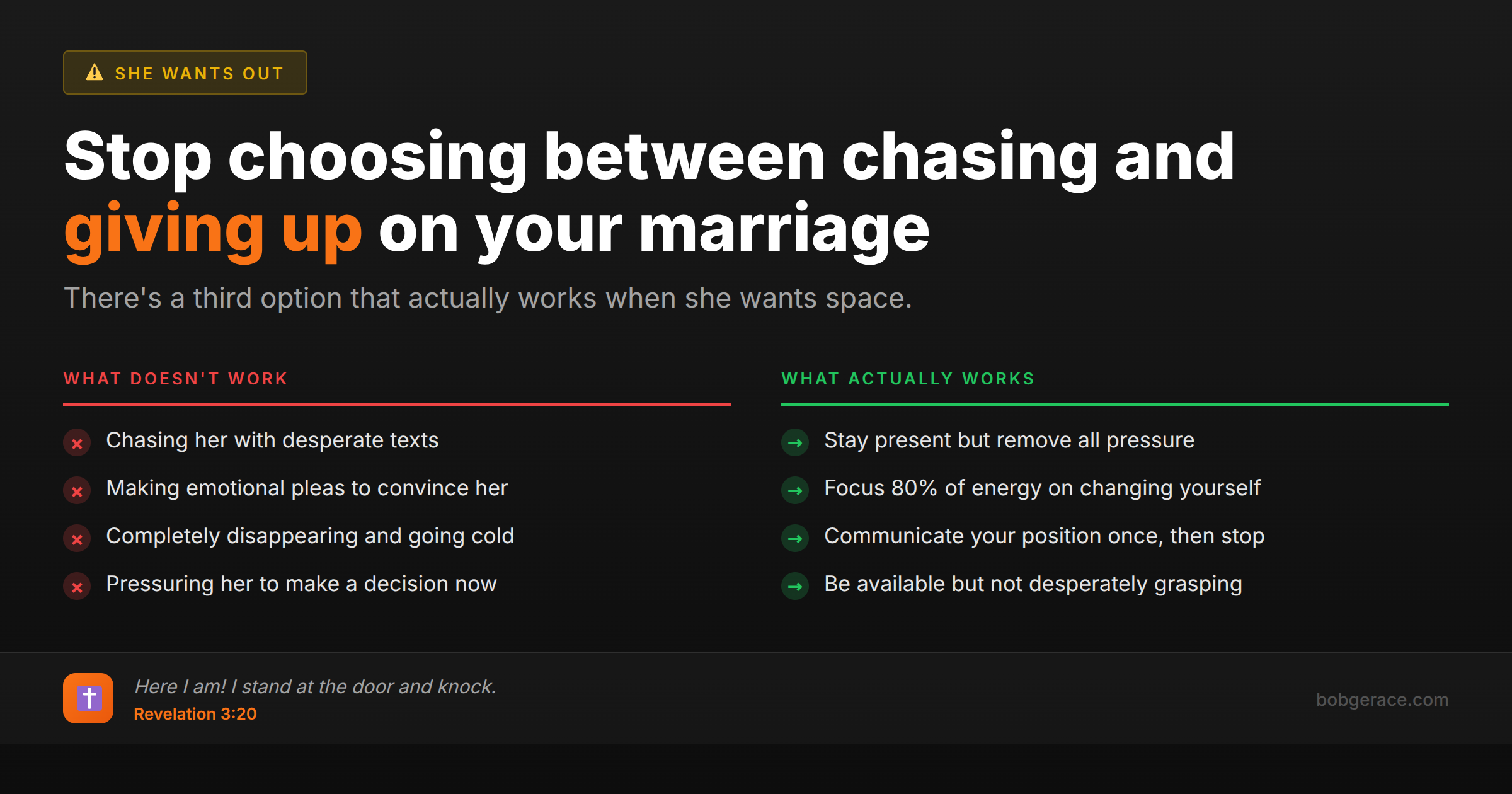
The answer isn't either/or - it's both, but with the right timing and approach. When your wife asks for space, honor that request initially. This isn't giving up; it's showing respect for her autonomy while you work on yourself. However, fighting for your marriage doesn't mean chasing, pleading, or violating boundaries. It means becoming the man she fell in love with and addressing the real issues that created distance. Most men make the mistake of either becoming a doormat or turning into a desperate pursuer. Both approaches push her further away. The key is strategic patience combined with intentional self-improvement. Give her the space she's asking for while you do the hard work of transformation. This positions you to re-engage from a place of strength, not desperation.
The Full Picture
This question reveals the internal war every man faces when his wife starts pulling away. You're torn between two powerful instincts: respect her wishes or fight for what matters most. Both instincts are valid, but timing and execution make all the difference.
When she asks for space, she's communicating something crucial about her emotional state. She feels overwhelmed, suffocated, or disconnected. Ignoring this request and pursuing harder will likely increase her resistance and push her toward more drastic measures like separation or divorce.
Here's what most men get wrong:
• They interpret giving space as giving up • They confuse fighting for the marriage with fighting against her wishes • They use the space to convince her instead of changing themselves • They violate boundaries thinking it shows love and commitment
The balanced approach looks different:
Respect her request for space while actively working on the issues that created distance. This isn't passive waiting - it's strategic preparation. Use this time to address your own shortcomings, understand what went wrong, and develop a plan for genuine change.
Space doesn't mean complete disconnection unless she specifically requests no contact. It means reducing pressure, eliminating needy behaviors, and giving her room to miss you. The goal is to become someone she wants to come back to, not someone she needs to avoid.
Remember, she didn't fall out of love overnight, and she won't fall back in love through pressure or manipulation. Real change takes time, and space provides the environment for both of you to gain clarity about what you truly want.
What's Really Happening
From a therapeutic perspective, the request for space often indicates emotional flooding or relationship fatigue. When someone asks for space, their nervous system is likely in a state of chronic activation - they feel constantly on guard, overwhelmed, or emotionally depleted within the relationship dynamic.
Research in attachment theory shows that when people feel their autonomy is threatened, they activate what we call the 'protest-despair-detachment' cycle. If pursuing behaviors continue despite requests for space, the person moves from protest (asking for space) to despair (feeling unheard) to detachment (emotional withdrawal or leaving).
The pursuing partner often experiences 'intermittent reinforcement anxiety' - the more unpredictable the connection becomes, the more they feel compelled to pursue. This creates a classic pursuer-distancer dynamic that becomes self-reinforcing. The pursuer's anxiety drives behaviors that increase the distancer's need for space.
Neurologically, when someone feels chronically pursued or pressured, their prefrontal cortex (responsible for connection and empathy) goes offline, while their amygdala (fight/flight/freeze response) becomes hyperactive. This means logical arguments or emotional appeals are literally not being processed normally.
The most effective intervention is what we call 'strategic withdrawal with self-focus.' This allows the distancer's nervous system to regulate while the pursuer addresses their own anxiety and attachment triggers. The goal isn't manipulation - it's creating conditions where both people can think clearly and make decisions from a regulated state rather than from fear or overwhelm.
This approach requires the pursuer to tolerate uncertainty while focusing on what they can actually control - their own growth and healing.
What Scripture Says
Scripture provides profound wisdom for navigating this tension between fighting for your marriage and respecting your wife's needs. The Bible calls us to both pursue righteousness and honor one another.
Philippians 2:3-4 instructs us: *'Do nothing out of selfish ambition or vain conceit. Rather, in humility value others above yourselves, not looking to your own interests but each of you to the interests of the others.'* This means considering what your wife truly needs, even when it's painful for you.
1 Peter 3:7 commands husbands to *'live with your wives in an understanding way, showing honor to the woman as the weaker vessel, since they are heirs with you of the grace of life.'* Understanding her need for space and honoring it demonstrates biblical leadership, not weakness.
However, this doesn't mean passive resignation. Ephesians 5:25-26 calls husbands to *'love your wives, just as Christ loved the church and gave himself up for her to make her holy, cleansing her by the washing with water through the word.'* Christ's love was sacrificial and transformative - He changed Himself for the church's benefit.
Proverbs 27:14 warns: *'Whoever blesses his neighbor with a loud voice, rising early in the morning, will be counted as cursing.'* Even good intentions become harmful when the timing and method are wrong.
Galatians 6:9 encourages: *'Let us not become weary in doing good, for at the proper time we will reap a harvest if we do not give up.'* The key phrase is 'proper time' - God's timing often requires patience and preparation.
Finally, Matthew 7:3-5 challenges us: *'First take the plank out of your own eye, and then you will see clearly to remove the speck from your brother's eye.'* Use this space to examine your own heart and behaviors before trying to fix the relationship.
What To Do Right Now
-
1
Tell her explicitly that you will respect her request for space and ask what specific boundaries she needs
-
2
Stop all pursuing behaviors including excessive texting, surprise visits, gifts, or conversations about the relationship
-
3
Identify the top three behaviors or patterns that contributed to her need for distance and begin addressing them
-
4
Establish your own support system including a counselor, mentor, or trusted friend who can provide accountability
-
5
Create a daily routine focused on your physical, emotional, and spiritual health rather than winning her back
-
6
Set a timeline for personal growth (30-90 days) before attempting any significant re-engagement conversations
Related Questions
- How much space is too much?
- What does 'space' actually mean to her?
- If I give space, won't she think I don't care?
- How do I fight without pushing her away?
- What's the difference between pursuing and chasing?
- When does giving space become abandonment?
- What is the '180' approach and does it work?
- How do I not pursue while also not abandoning?
- What does 'detach with love' actually mean?
- How do I pursue without pressuring?
Also find Bob on
Subscribe for weekly videos on Christian marriage.
Bring Your Actual Situation to Bob
Space, timing, her specific words — these details matter. A coach who knows your marriage can help you calibrate what to do this week, not just what works in theory.
Talk to Bob →