What do I say when kids ask what's happening?
5 min read
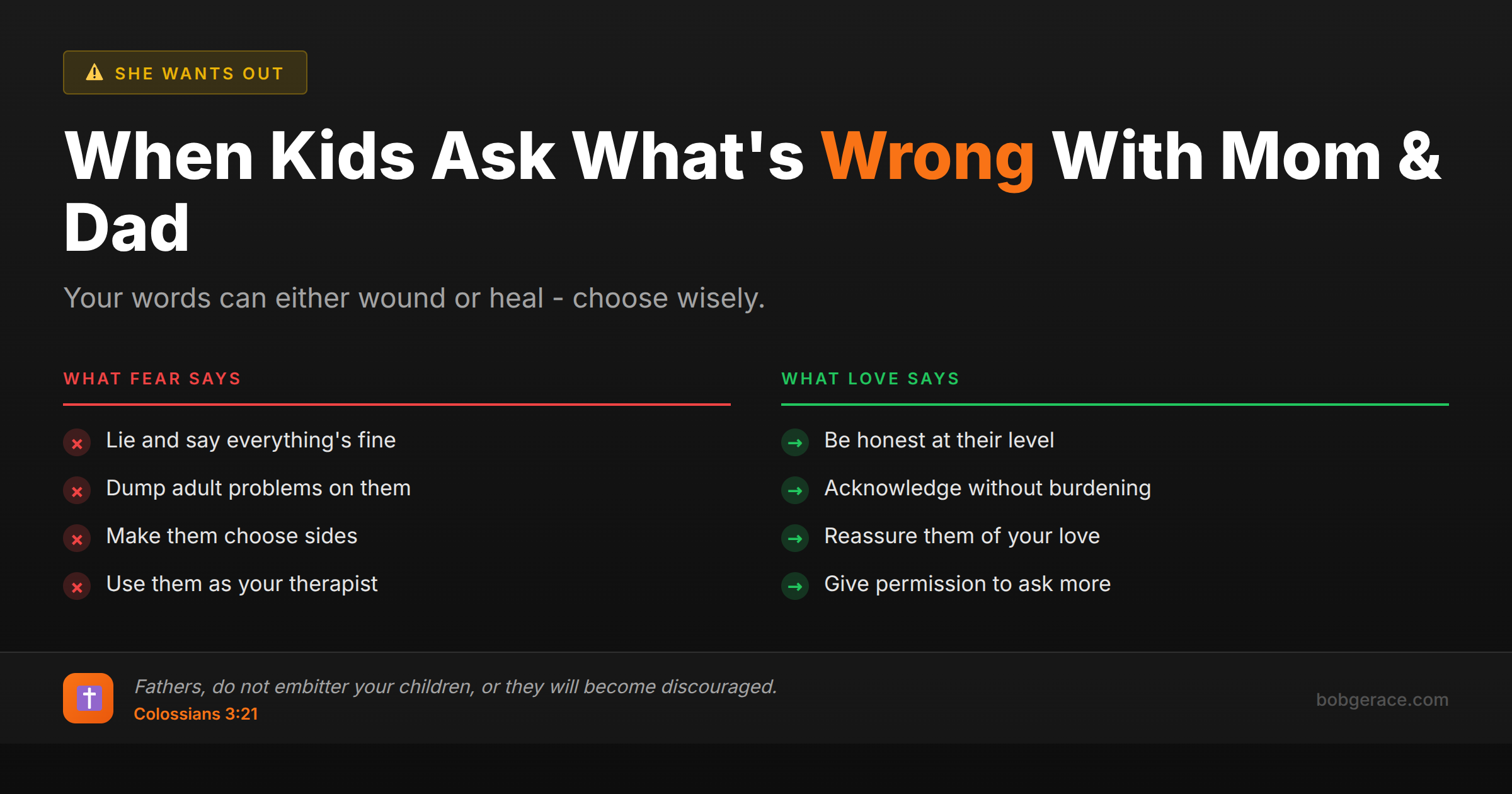
Your children already know something's wrong. They can feel the tension, see the tears, and sense the distance between their parents. The question isn't whether to tell them something—it's what to tell them and how. Start with their age and maturity level, but always lead with reassurance about their security. For younger kids: "Mom and Dad are having some grown-up problems we're working on, but we both love you very much and that will never change." For older children, you can be more specific about the challenges while still maintaining appropriate boundaries. The goal isn't to burden them with details, but to give them enough truth so their imagination doesn't create something worse than reality.
The Full Picture
Children are incredibly perceptive. They notice when Dad sleeps in the guest room, when Mom cries after phone calls, when family dinners become silent battlefields. Your silence doesn't protect them—it often makes things worse because kids will fill in the blanks with their imagination, and they usually imagine scenarios far worse than the truth.
The key is age-appropriate honesty. For children under 8, keep it simple: "Mom and Dad are having some problems right now, but we're both working hard to fix them. Sometimes grown-ups need help figuring things out, just like you might need help with a really hard puzzle."
For tweens and teens, you can be more direct: "Your mom and I are going through a difficult time in our marriage. We're getting help from a counselor to work on our problems. This isn't about you, and both of us love you completely."
Common mistakes parents make: • Using children as confidants or emotional support • Sharing adult details about infidelity, finances, or intimate problems • Making the other parent the villain • Pretending everything is fine when it clearly isn't • Making promises about outcomes you can't guarantee
What children need most: • Reassurance that both parents love them • Clear boundaries about what is and isn't their responsibility • Permission to have their own feelings • Consistent routines and stability where possible • Access to their own support (counselor, trusted adult, age-appropriate resources)
Remember, this conversation isn't a one-time event. Kids will have follow-up questions, concerns, and fears that surface over time. Create an environment where they feel safe asking questions without being shut down or overwhelmed with information they can't handle.
What's Really Happening
From a developmental perspective, children's ability to process and understand family crisis varies significantly by age and emotional maturity. Research shows that children as young as 2-3 years old can detect marital discord through changes in household emotional climate, even when parents believe they're hiding the conflict effectively.
Preschoolers (ages 3-5) tend to engage in magical thinking and may believe they caused the problems. They need concrete reassurances and simple explanations. School-age children (6-11) are developing logical thinking but still need protection from adult complexities. They benefit from honest but limited information that helps them make sense of changes in their environment.
Adolescents often demand more detailed explanations and may already be aware of specific issues. They can handle more nuanced conversations about relationships while still needing clear boundaries about what's appropriate to share.
The concept of "protective identification" is crucial here—children often absorb parents' emotional states and may try to fix or manage the family crisis. This can lead to anxiety, behavioral regression, academic problems, or taking on inappropriate adult responsibilities.
Key therapeutic principles: • Maintain the parent-child hierarchy by not reversing roles • Validate their emotions while providing reassurance about their security • Use concrete language rather than abstract concepts • Check for understanding and correct misconceptions • Monitor for signs of emotional distress requiring professional intervention
Children need to hear that the adult problems are being handled by adults, that professional help is involved when appropriate, and that their primary job remains being a child. This framework helps maintain their sense of safety while acknowledging their reality.
What Scripture Says
Scripture provides clear guidance about our responsibility to children during times of crisis. Ephesians 6:4 instructs us: "Fathers, do not exasperate your children; instead, bring them up in the training and instruction of the Lord." During marital crisis, this means avoiding actions that create unnecessary emotional burden or confusion.
Psalm 127:3 reminds us that "Children are a heritage from the Lord, offspring a reward from him." Even in our darkest moments, our children remain God's gifts entrusted to our care. This perspective helps us prioritize their wellbeing over our immediate emotional needs or desire to be "right" in the conflict.
Matthew 19:14 shows Jesus saying, "Let the little children come to me, and do not hinder them, for the kingdom of heaven belongs to such as these." We must not hinder our children's emotional and spiritual development by burdening them with adult problems or using them as emotional support systems.
1 Corinthians 13:11 acknowledges developmental stages: "When I was a child, I talked like a child, I thought like a child, I reasoned like a child." Our conversations must match their developmental capacity, not our adult need to explain or justify.
Proverbs 22:6 calls us to "Start children off on the way they should go, and even when they are old they will not turn from it." How we handle crisis teaches them about resilience, faith, and healthy relationships. Our response becomes part of their foundation for handling future difficulties.
Romans 8:28 promises that "in all things God works for the good of those who love him." While we cannot guarantee specific outcomes for our marriage, we can model faith that God is present in the struggle and can bring growth even through difficult circumstances. This hope, appropriately shared, can provide stability for children during uncertain times.
What To Do Right Now
-
1
Choose a calm moment when you won't be interrupted to have an initial age-appropriate conversation
-
2
Lead with reassurance about their security and your love before explaining any problems
-
3
Use simple, concrete language matched to their developmental level and avoid adult details
-
4
Ask what they've noticed or been wondering about, then address their specific concerns
-
5
Establish regular check-ins where they can ask questions or share their feelings safely
-
6
Monitor their behavior and emotional state for signs they need additional professional support
Related Questions
- How do I tell the kids?
- What do kids understand at different ages?
- What language is appropriate for each developmental stage?
- How do I be a good dad through this?
- What are signs my kids are struggling?
- How do I not badmouth her when I'm furious?
- How do I function at work after hearing this?
- What does self-care look like in this season?
- How do I grieve while also fighting?
- What is self-care in crisis?
Also find Bob on
Subscribe for weekly videos on Christian marriage.
You Don't Have to Script This Alone
What you say to your kids depends on their ages, what they've already seen, and where your marriage actually is right now. A coach who knows your specific situation can help you find the words that protect them without lying to them.
Talk to Bob →