What are the rules of separation?
5 min read
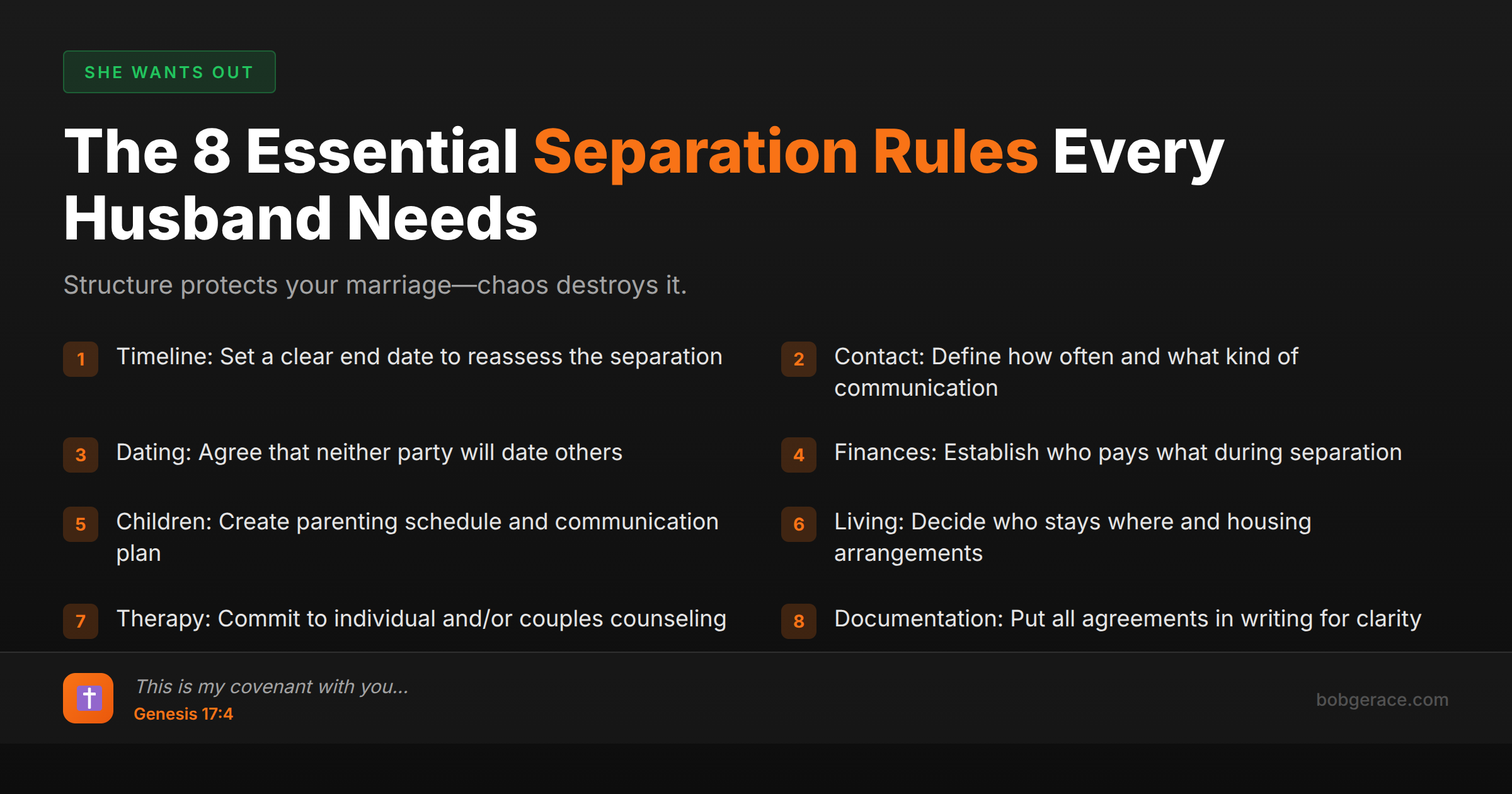
Separation without clear rules is chaos waiting to happen. The 'rules' aren't legal requirements - they're agreements between you and your wife about how you'll navigate this painful season while protecting both of you from further damage. The most critical areas that need clear boundaries are: living arrangements, financial responsibilities, communication protocols, dating/intimacy boundaries, co-parenting decisions, and timeline expectations. Without these guardrails, separation becomes a free-for-all that usually makes reconciliation harder, not easier. These rules aren't about control - they're about creating the space and structure needed for both of you to do the hard work of examining what went wrong and what needs to change.
The Full Picture
Separation rules fall into six critical categories:
Living Arrangements and Space Who stays in the house? Who moves out? How do you handle shared spaces if you're still under the same roof? These decisions set the tone for everything else. Many couples try "in-house separation" thinking it's easier, but it often creates more conflict and confusion.
Financial Boundaries Who pays what bills? How do you handle joint accounts? What spending requires discussion? Financial stress can torpedo any chance of reconciliation if not addressed upfront. Create a clear budget that covers both households if you're living separately.
Communication Guidelines This isn't about cutting off all contact - it's about healthy contact. Will you text daily? Call weekly? Meet for coffee monthly? What topics are off-limits? What happens when conversations get heated? Poor communication rules often lead to either complete shutdown or constant conflict.
Dating and Intimacy This is the big one that many couples avoid discussing. Are you dating other people? What about physical intimacy between yourselves? These boundaries need to be crystal clear, even if the conversation is uncomfortable.
Co-Parenting Protocols If you have kids, they need consistency and protection from adult drama. How will you handle school events, discipline, scheduling? Children shouldn't become messengers or emotional support systems for either parent.
Timeline and Review Points Separation without an endpoint becomes divorce by default. Set regular check-ins to assess progress, address problems, and make decisions about next steps. Most healthy separations have 3, 6, or 12-month review points.
The biggest mistake couples make is assuming they can "figure it out as they go." That's a recipe for disaster.
What's Really Happening
From a therapeutic perspective, separation rules serve as external structure when internal emotional regulation has broken down. When couples reach the separation point, their conflict patterns have typically become so entrenched that they can't navigate decisions together without triggering their trauma responses.
Research shows that structured separations with clear agreements have significantly better outcomes than unstructured separations. The Gottman Institute's work demonstrates that couples who establish explicit boundaries during separation are 40% more likely to successfully reconcile than those who don't.
Psychologically, rules provide safety and predictability during a time of intense uncertainty. They reduce what we call 'ambiguous loss' - the painful state of not knowing whether the relationship is ending or continuing. This ambiguity keeps both partners in a state of hypervigilance that prevents the emotional healing necessary for either reconciliation or healthy divorce.
The rules also serve another critical function: they force couples to practice collaborative decision-making at a time when collaboration feels impossible. When couples can successfully negotiate and maintain separation agreements, they're rebuilding the relationship skills that broke down in the first place.
However, rules without accountability mechanisms rarely work. Couples need external support - whether through counseling, coaching, or trusted friends - to maintain these boundaries when emotions run high. The prefrontal cortex, responsible for executive function and decision-making, is significantly impaired during high stress, making it nearly impossible to maintain agreements without external scaffolding.
What Scripture Says
Scripture provides clear principles for how believers should handle conflict and difficult seasons in marriage. 1 Corinthians 7:10-11 addresses separation directly: "To the married I give this command (not I, but the Lord): A wife must not separate from her husband. But if she does, she must remain unmarried or else be reconciled to her husband. And a husband must not divorce his wife." This passage acknowledges that separation happens while affirming that reconciliation remains the goal.
Matthew 18:15-17 gives us the framework for addressing conflict: "If your brother or sister sins, go and point out their fault, just between the two of you. If they listen to you, you have won them over. But if they will not listen, take one or two others along, so that 'every matter may be established by the testimony of two or three witnesses.'" This principle of structured, escalating accountability applies to separation agreements.
Ecclesiastes 3:7 reminds us that there is "a time to be silent and a time to speak." Separation rules help couples discern when and how to communicate rather than reacting from raw emotion.
1 Corinthians 10:24 instructs us to "not seek your own good, but the good of the other." Even in separation, believers are called to consider their spouse's wellbeing, not just their own desires or rights.
Proverbs 27:14 warns about poor boundaries: "Whoever blesses their neighbor with a loud voice in the morning will be cursed as a curse to them." Sometimes love requires space and restraint, not constant pursuit.
Galatians 6:1-2 calls us to "restore gently" while "carrying each other's burdens." Separation rules should reflect this spirit of gentle restoration, not punishment or revenge.
What To Do Right Now
-
1
Schedule a calm conversation with your wife to discuss creating separation agreements
-
2
Draft written agreements covering living arrangements, finances, communication, and timeline
-
3
Establish regular check-in dates to review how the agreements are working
-
4
Identify a neutral third party (counselor, pastor, trusted friend) to help maintain accountability
-
5
Create clear protocols for what happens when agreements are broken or need modification
-
6
Document everything in writing and ensure both parties have copies of all agreements
Related Questions
- She wants separation — should I agree?
- Should I move out if she asks?
- Is trial separation ever a good idea?
- What is 'structured separation' and does it work?
- What boundaries make separation therapeutic?
- What does healthy communication during separation look like?
- What boundaries should I set?
- What's the difference between boundary and ultimatum?
- What makes boundaries healthy?
- How do I co-parent during this?
Also find Bob on
Subscribe for weekly videos on Christian marriage.
Don't Wing the Rules for Your Separation
A coach who knows your marriage can help you set boundaries that protect both of you—and keep the door open. You don't have to figure this out by yourself.
Talk to Bob →